Coppock Curve
Indicators · Momentum
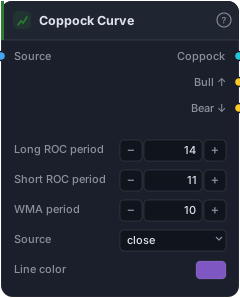
Coppock Curve — long-term momentum (WMA of two ROCs).
The Coppock Curve is a long-term momentum indicator famous for one job: spotting major bottoms. Edwin Coppock designed it in 1962 to identify generational buying opportunities in stock indices, and traders still watch it for exactly that. It's a slow, smooth oscillator — built for monthly and weekly charts — whose turn up from below zero has historically marked the start of major bull moves with a striking hit rate.
How it works
The block sums two Rate of Change measurements — over the Long ROC period (14) and Short ROC period (11) — then smooths the sum with a WMA over the WMA period (10). Combining two ROC horizons captures momentum across cycles; the weighted smoothing strips out the noise. The result, the Coppock line, oscillates slowly around zero in a sub-pane, with Bull ↑ / Bear ↓ signals on the zero cross. The classic signal is specifically the curve turning up while below zero.
When to use it
Use the Coppock Curve for long-term, position-level timing — it's a higher-timeframe tool, traditionally on monthly (or weekly) charts of indices and major instruments. Its signature signal is the upturn from below zero, read as a major bottom and a long-term buy. It is emphatically not a short-term or intraday tool: on fast timeframes its slowness makes it useless. Treat it as a strategic regime/bias indicator that says "the long-term tide has turned," then use faster tools for entry timing.
Example
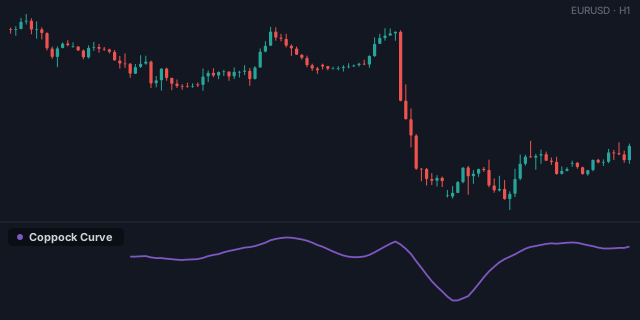
A long-term bias: on a weekly or monthly chart, compute the Coppock Curve and treat a Bull ↑ turn up from below zero as a long-term bullish regime; gate your position-trading longs to only fire while Coppock is rising, combined through an And gate. Backtest on higher-timeframe data in the Tester.
Tips & gotchas
- A major-bottom finder — its fame is the upturn from below zero on long timeframes.
- Monthly/weekly only — useless on fast charts; it's a strategic, slow tool.
- Built from two ROCs + a WMA — multi-horizon momentum, smoothed.
- Bias, not entry — pair with a faster trigger for timing.
Related blocks
Inputs
| Socket | Type | What to wire in |
|---|---|---|
| Source | bars / series |
Price bars or any indicator series |
Outputs
| Output | Type | Plots as | Description |
|---|---|---|---|
| Coppock | series |
Line · sub-pane | Coppock Curve value |
| Bull ↑ | signal |
Signal arrows | Coppock crosses above zero |
| Bear ↓ | signal |
Signal arrows | Coppock crosses below zero |
Parameters
| Parameter | Type | Default | What it does |
|---|---|---|---|
| Long ROC period | number · 2–200 | 14 |
|
| Short ROC period | number · 2–200 | 11 |
|
| WMA period | number · 2–100 | 10 |
|
| Source | choice (close, open, high, low, hl2, hlc3, ohlc4) |
close |
|
| Line color | colour | #7e57c2 |
Reference auto-generated from the block catalog · category Indicators.