Fixed Stop-Loss
Risk · Stop Loss
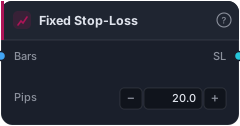
Constant stop-loss distance in pips. Wire its output into the Output node's SL socket. Equivalent to setting the Output's inline SL value, but composes with other blocks (e.g. you can branch the same SL into RRTarget for the matching TP).
Fixed Stop-Loss sets a constant stop distance — a fixed number of pips — for every trade. It's the simplest risk leg there is: "always risk 20 pips." You wire its output into the Tester's (or EA Output's) SL socket, and every trade gets that stop. It does the same job as typing a number into the Tester's inline SL slider, but as a block — which is what makes it composable.
How it works
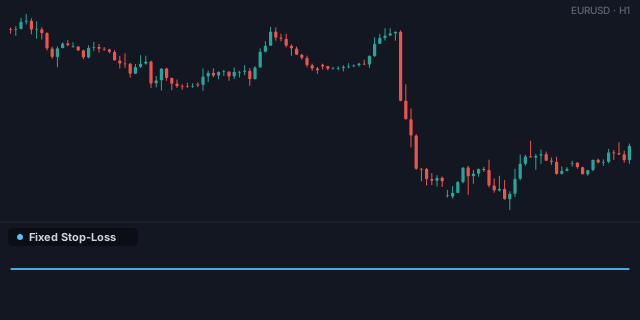
The block emits a per-bar series holding a constant Pips value (default 20). The Bars input is just there to align that series to your timeframe. The reason to use the block rather than the inline slider is composition: you can branch the same SL into a Reward-to-Risk Target so your TP is always a multiple of your actual stop. Wire FixedSL into both the Tester's SL socket and an RR Target, and the two legs stay in lockstep automatically.
When to use it
Use Fixed Stop-Loss when your risk per trade is a flat distance — common in systems on a single instrument and timeframe where pip volatility is roughly stable. It's the natural partner of Reward-to-Risk Target for clean, fixed-R systems. When volatility varies (across sessions, instruments, or regimes), a volatility-scaled stop (ATR×N) usually serves better — but even then, FixedSL is the clearest starting point to establish a baseline.
Example
A fixed-R system: wire Bars into Fixed Stop-Loss at 20 pips, branch its output into both the Tester's SL socket and a Reward-to-Risk Target at 2×, then wire the RR Target's output into the Tester's TP socket. Every trade now risks 20 to make 40. Backtest in the Tester.
Tips & gotchas
- Use the block, not just the slider, to compose — branching it into Reward-to-Risk Target keeps SL and TP locked together.
- Fixed distance ignores volatility — fine on a stable instrument/timeframe; for varying volatility, an ATR-scaled stop adapts.
- Pips are the unit — make sure the value suits the instrument (20 pips means very different risk on EURUSD vs a fast crypto pair).
- It's a leg, not an exit by itself — the Tester/EA Output applies it.
Related blocks
Inputs
| Socket | Type | What to wire in |
|---|---|---|
| Bars | bars |
Bars to align the output series to. |
Outputs
| Output | Type | Plots as | Description |
|---|---|---|---|
| SL | series |
Line · sub-pane | Per-bar SL distance in pips. |
Parameters
| Parameter | Type | Default | What it does |
|---|---|---|---|
| Pips | number · 0.1–1000.0 | 20.0 |
Reference auto-generated from the block catalog · category Risk.