Force Index
Indicators · Volume
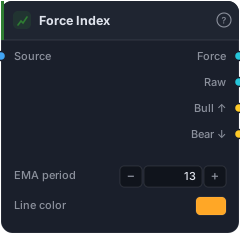
Elder's Force Index — volume-weighted close-to-close momentum, EMA-smoothed.
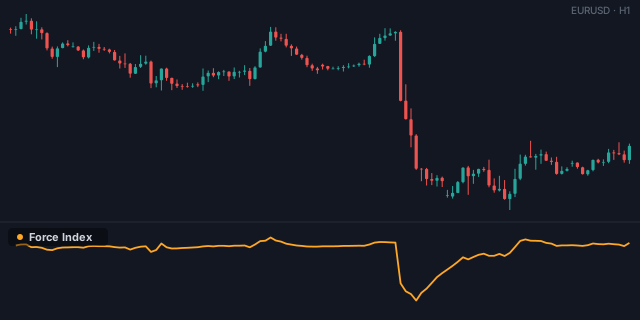
Alexander Elder's Force Index combines the three things that define the power behind a price move: its direction, its size, and the volume that drove it. The logic is intuitive — a big up-move on heavy volume has real force behind it; the same move on thin volume is weak and likely to fade. It rolls all three into a single oscillator around zero, giving you a read on whether bulls or bears are genuinely in control and how strongly.
How it works
The raw force for each bar is (close − previous close) × volume — direction and size from the price change, conviction from the volume. That Raw line is jumpy, so the block also gives you a Force line that smooths it with an EMA over the EMA period (default 13). Positive readings mean bulls are pushing; negative means bears; the magnitude is the strength. The block fires Bull ↑ / Bear ↓ signals when the smoothed Force crosses zero. On forex it uses tick volume.
When to use it
Elder's own framework uses two Force Indexes. A short one (period ~2) is a sensitive entry timer — in an uptrend, a dip in the 2-period Force below zero flags a pullback to buy. A longer one (13+) reads the underlying trend's force and is best for divergence — fading force while price makes new highs warns of exhaustion. So: short Force for timing within a trend, long Force for trend strength and divergence. The zero-line cross is a momentum-shift signal.
Example
A pullback-in-trend entry: with bias up from a 200-EMA, wire bars into a Force Index (short EMA period) and buy when the Raw/Force dips below zero then recovers via a Crosses Above into a Tester — buying the volume-confirmed pullback. Protect with a Tester and backtest in the Tester.
Tips & gotchas
- Two periods, two jobs. Short (~2) for pullback timing, long (13+) for trend force and divergence.
- Raw is for timing, Force is for trend. The unsmoothed line catches quick pullbacks; the smoothed one reads the bigger picture.
- Zero cross = momentum shift, but it's noisy on the short setting — that noise is the entry signal in Elder's method.
- Tick volume on forex — directional proxy, not contract size.
Related blocks
Inputs
| Socket | Type | What to wire in |
|---|---|---|
| Source | bars |
Price bars (needs close + volume) |
Outputs
| Output | Type | Plots as | Description |
|---|---|---|---|
| Force | series |
Line · sub-pane | EMA-smoothed Force Index |
| Raw | series |
Line · sub-pane | Single-bar Force (close-to-close × volume), unsmoothed |
| Bull ↑ | signal |
Signal arrows | Force crosses above zero |
| Bear ↓ | signal |
Signal arrows | Force crosses below zero |
Parameters
| Parameter | Type | Default | What it does |
|---|---|---|---|
| EMA period | number · 1–200 | 13 |
|
| Line color | colour | #ffa726 |
Reference auto-generated from the block catalog · category Indicators.