Ichimoku Cloud
Indicators · Trend
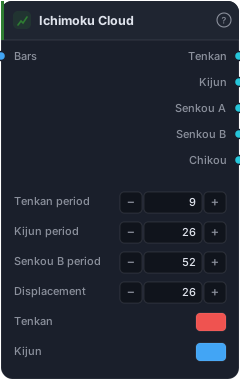
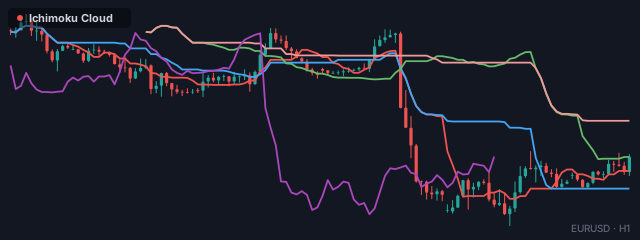
Ichimoku Kinkō Hyō — Tenkan, Kijun, Senkou A/B, Chikou.
Ichimoku Kinkō Hyō ("one-glance equilibrium chart") is a complete trading system in a single indicator. Despite looking busy, it's designed to give you trend, momentum, support/resistance, and signals at a glance — once you learn to read it. Its centrepiece is the Cloud (Kumo), a shaded band projected ahead of price that acts as dynamic support/resistance and colours the overall bias: price above the cloud is bullish, below is bearish, inside is no-man's-land.
How it works
Five lines work together. Tenkan-sen (Conversion, Tenkan period 9) and Kijun-sen (Base, Kijun period 26) are midpoints of recent highs/lows — fast and slow trend lines whose cross is a signal. Senkou Span A (the Tenkan/Kijun midpoint) and Senkou Span B (midpoint over Senkou B period 52) are plotted Displacement bars into the future (26) — the gap between them is the Cloud. Chikou Span is the close plotted 26 bars into the past, used to confirm signals against historical price. Each line has its own colour.
When to use it
Use Ichimoku as an all-in-one trend and confirmation framework. The highest-conviction setup stacks every element: price above the cloud (bull bias), Tenkan above Kijun (momentum up), a green cloud ahead (future support), and Chikou above past price (confirmation) — when all align, the trend is strong. The Kijun is a superb trailing reference and dynamic support; the cloud edges are watched support/resistance. It's a trend-following system — it lags and gets chopped in ranges, where the cloud goes thin and flat.
Example
A full-stack long: wire bars into Ichimoku and require price above the cloud and a Tenkan-crosses-Kijun event — combine the bias and the Crosses Above trigger through an And gate into a Tester. Use the Kijun as your trailing stop via a Tester and backtest in the Tester.
Tips & gotchas
- It's a system, not a single line. Its power is the confluence of all five elements — don't trade one in isolation.
- The cloud is bias + support/resistance projected ahead; a thick cloud is strong S/R, a thin one is weak.
- Best on higher timeframes (H4/D1) where the classic 9/26/52 settings were designed to work.
- Lags and chops in ranges — when the cloud flattens, stand aside.
- Defaults encode trading-week structure — change 9/26/52 only with good reason.
Related blocks
Inputs
| Socket | Type | What to wire in |
|---|---|---|
| Bars | bars |
Price bars |
Outputs
| Output | Type | Plots as | Description |
|---|---|---|---|
| Tenkan | series |
Line | Tenkan-sen (Conversion Line) |
| Kijun | series |
Line | Kijun-sen (Base Line) |
| Senkou A | series |
Line | Senkou Span A (shifted forward) |
| Senkou B | series |
Line | Senkou Span B (shifted forward) |
| Chikou | series |
Line | Chikou Span (close shifted backward) |
Parameters
| Parameter | Type | Default | What it does |
|---|---|---|---|
| Tenkan period | number · 2–200 | 9 |
|
| Kijun period | number · 2–500 | 26 |
|
| Senkou B period | number · 2–500 | 52 |
|
| Displacement | number · 1–200 | 26 |
|
| Tenkan | colour | #ef5350 |
|
| Kijun | colour | #42a5f5 |
|
| Senkou A | colour | #66bb6a |
|
| Senkou B | colour | #ef9a9a |
|
| Chikou | colour | #ab47bc |
Reference auto-generated from the block catalog · category Indicators.