Liquidity Sweep
Structure · Smart Money

Detects bars that take out a recent swing and close back inside.
A Liquidity Sweep is the footprint of a stop hunt. Below an obvious swing low sit clusters of stop-loss and breakout-sell orders — liquidity — and above an obvious swing high sit the buy-side equivalents. Smart money often pushes price just far enough to trigger that liquidity, then immediately reverses, leaving behind a telltale wick. This block detects exactly that: a bar that takes out a recent swing and then closes back inside the range. It's one of the highest-quality reversal cues in smart-money trading because it marks the moment the trap sprang.
How it works
Using a fractal swing defined by the Swing window (default 5 — a 5-bar confirmation on each side), the block watches for a bar whose high pushes above a recent swing high (or whose low pushes below a recent swing low) but which then closes back within the prior range. That failure to hold the breakout — the long wick beyond the level, the close back inside — is the sweep. Each detection is emitted as a sweep event. Because the swing reference needs confirmation, sweeps are identified honestly without peeking ahead.
When to use it
Use Liquidity Sweep as a reversal trigger, especially at the end of a move into an obvious level (a prior swing, a session high/low, a round number). The play: a sweep below a swing low that closes back inside signals sellers got trapped — look for longs; a sweep above a swing high signals trapped buyers — look for shorts. It works best with confluence: a sweep into a Supply/Demand Zone or followed by a Market Structure shift is far stronger than a sweep in isolation. It's a counter-move tool — don't take every wick as gospel.
Example
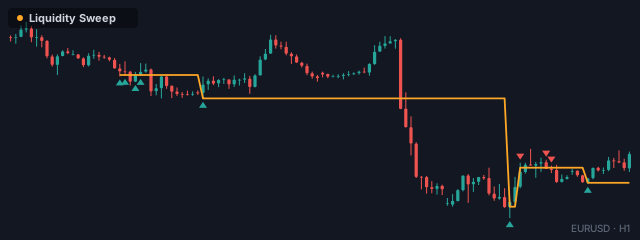
A sweep-reversal long: wire bars into Liquidity Sweep and combine a bullish sweep (swing low taken, close back inside) with price sitting in a Supply/Demand Zone through an And gate into a Tester. Place the Tester just beyond the sweep's wick (where the trapped traders' stops now sit) and target a Tester of 2–3×. Backtest in the Tester.
Tips & gotchas
- The close-back-inside is the signal, not the spike alone — a bar that sweeps and holds beyond the level is a breakout, not a sweep.
- Best with confluence — a sweep into a zone or before a CHoCH is far stronger than a lone wick.
- Stop goes beyond the wick — past where the trapped traders' stops cluster.
- Obvious levels hold the most liquidity — equal highs/lows, session extremes, round numbers are prime sweep targets.
Related blocks
Inputs
| Socket | Type | What to wire in |
|---|---|---|
| Bars | bars |
Price bars |
Outputs
| Output | Type | Plots as | Description |
|---|---|---|---|
| Sweeps | events |
— | Sweep events |
| Sweep high | signal |
Signal arrows | Bearish sweep on this bar (took out a swing high, closed back below). |
| Sweep low | signal |
Signal arrows | Bullish sweep on this bar (took out a swing low, closed back above). |
| Swept level | series |
Line | Price of the last swept swing, held forward (stop reference). |
Parameters
| Parameter | Type | Default | What it does |
|---|---|---|---|
| Swing window | number · 1–50 | 5 |
Half-width of the fractal — 5 means a 5-bar confirmation on each side |
Reference auto-generated from the block catalog · category Structure.