Outside Bar
Indicators · Price Action
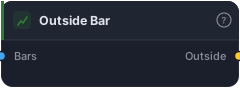
True when this bar's range fully engulfs the prior bar's (high > prior high AND low < prior low).
Outside Bar fires when the current bar's range fully engulfs the previous bar's — its high is above the prior high and its low is below the prior low. It marks an expansion bar that traded both sides of the last bar's range, a sign of volatility and a potential reversal or breakout.
How it works
From the bars input it checks high > prior high AND low < prior low (strict on both sides). When both hold, the signal is True. It compares against the immediately prior bar only. Lookahead-free, no parameters.
When to use it
Use it to flag range expansion and two-sided rejection: an outside bar at a level often signals a stop-run and reversal, and outside bars mark where volatility just jumped. Because a single bar swept both extremes, it pairs well with a directional filter — treat a bullish-closing outside bar at support differently from a bearish one.
Example
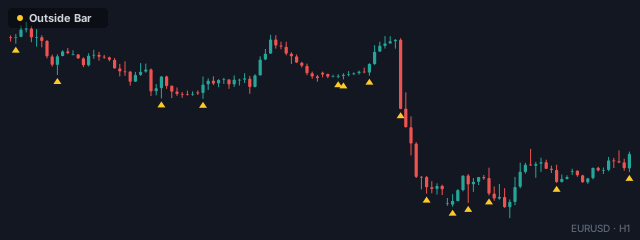
Reversal expansion: when Outside Bar is true and the bar closes up (via Candle Anatomy or a close-vs-open check) at a demand zone, And those and enter long in the Tester — a two-sided sweep that closed strong.
Tips & gotchas
- Strict bounds (
>/<) — it must exceed the prior bar on both sides. - One-bar comparison — immediately prior bar only.
- Opposite of Inside Bar; combine with close direction/location for a tradeable edge.
Related blocks
Inputs
| Socket | Type | What to wire in |
|---|---|---|
| Bars | bars |
Price bars. |
Outputs
| Output | Type | Plots as | Description |
|---|---|---|---|
| Outside | signal |
Signal arrows | Outside bar. |
Reference auto-generated from the block catalog · category Indicators.