Risk/Reward Target
Risk · Take Profit
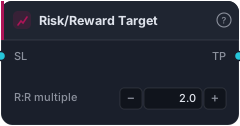
Take-profit at N×risk. Reads an SL series from upstream (FixedSL, ATR-based stop, etc.) and emits TP = SL × RR. Wire the matching SL into the Output's SL socket and this block's output into the Output's TP socket.
Risk/Reward Target sets your take-profit as a multiple of your risk, not a fixed pip number. Tell it "2R" and it places the target twice as far as your stop — whatever your stop happens to be. This is the professional way to set targets: your reward is always defined relative to what you're risking, so position management stays consistent whether the stop is 10 pips or 60. It's the block that makes "risk 1 to make 2" automatic.
How it works
The block reads an SL series from upstream — from a Fixed Stop-Loss, an ATR-based stop, a Structural Stop, anything that emits a per-bar pip distance — and outputs TP = SL × RR, where R:R multiple defaults to 2.0. Because it consumes the same stop series you feed into the Tester, the target always matches the actual risk on every bar. Wire the stop into the Tester's SL socket and into this block, then wire this block's output into the Tester's TP socket.
When to use it
Use Risk/Reward Target for any system where you think in R-multiples — which is most disciplined approaches. It's especially powerful with variable stops: pair it with an ATR or Structural Stop and your target automatically widens in volatile conditions and tightens in calm ones, always holding the same reward ratio. Choosing the RR is a real strategic decision: a high RR (3R+) needs a lower win rate to profit but means fewer winners reach target; a low RR (1–1.5R) hits more often but demands a higher win rate. The Tester is where you find the balance.
Example
Volatility-scaled, fixed-R: build an ATR×2 stop series, wire it into the Tester's SL socket and into Risk/Reward Target at 2.0, then wire the RR Target output into the Tester's TP socket. Now both stop and target breathe with volatility while the 2:1 ratio holds. Backtest in the Tester and sweep the RR to find the sweet spot.
Tips & gotchas
- Feed it the same stop you give the Tester — that's what keeps reward locked to actual risk.
- Shines with variable stops (ATR/Structural Stop) — target auto-scales with volatility.
- RR is a strategic dial — high RR = lower win rate needed but fewer targets hit; low RR = the reverse. Sweep it.
- It only sets the target distance — the Tester applies the exit.
Related blocks
Inputs
| Socket | Type | What to wire in |
|---|---|---|
| SL | series |
SL series in pips. The TP is this × RR. |
Outputs
| Output | Type | Plots as | Description |
|---|---|---|---|
| TP | series |
Line · sub-pane | Per-bar TP distance in pips. |
Parameters
| Parameter | Type | Default | What it does |
|---|---|---|---|
| R:R multiple | number · 0.1–20.0 | 2.0 |
Reference auto-generated from the block catalog · category Risk.