Rising
Signals · Comparison
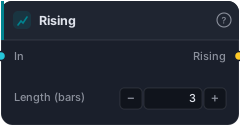
True when the series strictly rose on each of the last N bars.
Rising fires when a series has gone strictly up on each of the last N bars in a row — a clean "this line is consistently climbing" confirmation. Instead of reacting to a single up-tick, it waits for a run of higher values, filtering out one-bar noise before it calls something an uptrend.
How it works
Each bar it checks that the input increased on every one of the previous length bar-to-bar steps (each value strictly greater than the one before). Only then is the signal True; a single flat or down step breaks the run and returns False. It can't fire until at least length prior bars exist. Lookahead-free.
When to use it
Use it as a momentum or slope confirmation: require an indicator to be Rising for a few bars before trusting a breakout, or gate an entry so it only fires while your signal line is genuinely trending up. It's the discrete, thresholds-free cousin of Rolling Slope — good when you want a simple yes/no on "is this climbing."
Example
Confirmed momentum long: wire an EMA into Rising (length = 3), And it with your entry trigger, and feed that into the Tester — longs only fire when the EMA has risen three bars straight.
Tips & gotchas
- Strict — a flat bar (equal values) breaks the run, it doesn't extend it.
- Longer
length= stronger confirmation but more lag and fewer signals. - Pair with Falling for the down-side; use Rolling Slope if you want the rate, not just the yes/no.
Related blocks
Inputs
| Socket | Type | What to wire in |
|---|---|---|
| In | series / bars |
Series to test. BARS uses close. |
Outputs
| Output | Type | Plots as | Description |
|---|---|---|---|
| Rising | signal |
Signal arrows | Strictly increasing over N bars. |
Parameters
| Parameter | Type | Default | What it does |
|---|---|---|---|
| Length (bars) | number · 1–500 | 3 |
Number of consecutive bars to test. |
Reference auto-generated from the block catalog · category Signals.