Sell Signal
EA · Entries
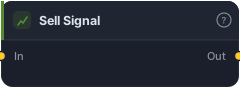
When true, open a short position. Wire into EAOutput.entry_short.
Sell Signal marks a condition as your short entry for an exported / live strategy. When the boolean you wire in is true, the strategy opens a short. Like its long counterpart it's a labelling block — it names the role of a signal so the EA Output knows "this is the sell trigger," and so the graph reads clearly about which condition opens shorts.
How it works
It's a pass-through: one signal In, the same signal Out, unchanged. Wire your short-entry logic into it and route its output into the EA Output's short-entry socket. It adds no logic — it tags purpose. (For chart backtesting you'd wire short logic into the Tester's Sell socket directly; Sell Signal is the EA-side equivalent.)
When to use it
Use Sell Signal when building for EA Output and you want the short-entry condition named and routed. It's the EA counterpart of the Tester's Sell socket, and it keeps a two-sided (long and short) strategy organised about which condition does what.
Example
Label a short entry: wire a Crosses Below (fast MA under slow) into Sell Signal, then route it into the EA Output's short-entry input. The strategy now opens a short whenever that bearish crossover fires.
Tips & gotchas
- Pass-through, not logic — it labels the short trigger; it doesn't alter it.
- EA-side counterpart of the Tester's Sell socket.
- Pair long + short with Buy Signal for a two-sided system, kept readable.
- Mind opposing signals — in many engines an opposite entry closes the current position; design your long/short conditions so they don't fight.
Related blocks
Inputs
| Socket | Type | What to wire in |
|---|---|---|
| In | signal |
Entry/exit trigger |
Outputs
| Output | Type | Plots as | Description |
|---|---|---|---|
| Out | signal |
— | Pass-through signal |
Reference auto-generated from the block catalog · category EA.