Sequence (A then B)
Flow · Counter
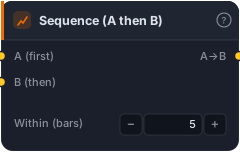
True on a bar where B is true AND A was true within the last N bars — 'A happened, THEN B within N'. The ordered-confluence primitive for setups like break→retest, cross→pullback, sweep→confirmation.
Sequence enforces order: it fires on a bar where B is true and A was true within the last N bars — "A happened, then B soon after." It's the ordered-confluence primitive for multi-step setups where the sequence matters, not just that both things eventually occurred.
How it works
Two signal inputs, A and B, and a window. Each bar it checks whether B is true now and A was true on any of the previous window bars (inclusive). Only then does it output True. Order is enforced — A must precede B; B firing without a recent A does nothing. Lookahead-free.
When to use it
Use it for staged patterns: break → retest (A = break, B = retest touch), cross → pullback, liquidity sweep → confirmation, signal → trigger. Plain And only asks "are both true on this bar," which misses setups that unfold over several bars; Sequence captures the "first this, then that, within a window" shape those setups actually have.
Example
Break-and-retest: wire a "broke resistance" signal into A and a "closed back above the level" signal into B, with window = 5. Sequence fires when the retest confirmation lands within five bars of the break — feed it into the Tester as the entry.
Tips & gotchas
- Order matters — A must come first; swapping A and B changes the meaning.
- Window is the patience — how many bars B has to show up after A.
- A within the window includes the current bar, so simultaneous A+B also fires.
- Both inputs must be signals.
Related blocks
Inputs
| Socket | Type | What to wire in |
|---|---|---|
| A (first) | signal |
The condition that must happen FIRST. |
| B (then) | signal |
The condition that confirms, within N bars after A. |
Outputs
| Output | Type | Plots as | Description |
|---|---|---|---|
| A→B | signal |
Signal arrows | B true with A within the last N bars. |
Parameters
| Parameter | Type | Default | What it does |
|---|---|---|---|
| Within (bars) | number · 1–500 | 5 |
How many bars after A that B still counts. |
Reference auto-generated from the block catalog · category Flow.