Accumulation / Distribution
Indicators · Volume
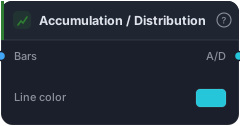
Cumulative money-flow volume — the A/D line.
The Accumulation/Distribution line (A/D) is a cumulative running total of money-flow volume — a close cousin of OBV, but more nuanced. Where OBV adds the whole bar's volume based only on whether the close was up or down, the A/D line weights each bar's volume by where the close landed within its range. A bar that closes near its high adds more than one that closes mid-range, even if both closed up. The result is a smoother, more sensitive measure of whether an instrument is being quietly accumulated or distributed.
How it works
Each bar the block computes the close-location multiplier — ((close − low) − (high − close)) / (high − low), +1 at the high, −1 at the low — multiplies by volume, and adds the result to a running cumulative total (the same money-flow volume that Chaikin Money Flow averages, but accumulated rather than ratio'd). The output is a single ever-rising-or-falling line in a sub-pane. As with OBV, the absolute value is arbitrary; direction and divergence are everything.
When to use it
Use the A/D line to confirm trends and, above all, to spot divergence. A rising A/D line confirms buyers are in control even on quiet days; a falling A/D while price holds up warns of distribution beneath the surface. Because it's range-weighted it reacts to subtle shifts OBV would miss — but that sensitivity also means a single odd bar (a big gap, a close pinned mid-range) can nudge it. It's a confirmation and early-warning tool, not a trigger, and uses tick volume on forex.
Example
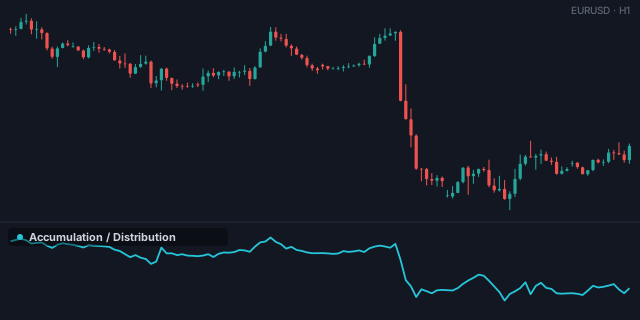
Confirm accumulation: wire bars into Accumulation/Distribution and require the line rising alongside your long trigger through an And gate into a Tester. Use the Tester review to check whether failed trades showed A/D divergence beforehand.
Tips & gotchas
- Range-weighted, unlike OBV. It captures where in the bar price closed, not just up/down — smoother and more sensitive.
- Direction and divergence only — the absolute level is meaningless.
- Gap-sensitive. A bar that gaps and closes mid-range can distort it, since it ignores gaps between bars.
- No period to tune — it's a pure cumulative line; the Chaikin Oscillator adds smoothing on top.
Related blocks
Inputs
| Socket | Type | What to wire in |
|---|---|---|
| Bars | bars |
Price bars |
Outputs
| Output | Type | Plots as | Description |
|---|---|---|---|
| A/D | series |
Line · sub-pane | A/D cumulative value |
Parameters
| Parameter | Type | Default | What it does |
|---|---|---|---|
| Line color | colour | #26c6da |
Reference auto-generated from the block catalog · category Indicators.