Chaikin Money Flow
Indicators · Volume
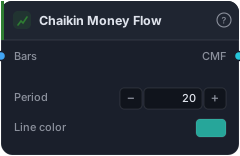
Chaikin Money Flow — N-period money-flow volume ratio.
Chaikin Money Flow (CMF) measures whether money has been flowing into or out of an instrument over a recent window, on a scale of −1 to +1. Marc Chaikin's insight was that where a bar closes within its range reveals buying or selling pressure: closes near the high mean buyers dominated, closes near the low mean sellers did. Weight that by volume and sum it over a period, and you get a clean read of accumulation (positive) versus distribution (negative).
How it works
For each bar the block computes a "money flow multiplier" from where the close sits in the bar's range — ((close − low) − (high − close)) / (high − low), which runs from +1 (close on the high) to −1 (close on the low). It multiplies that by volume to get money-flow volume, then divides the sum of money-flow volume by the sum of volume over the Period (default 20). The result oscillates around zero between −1 and +1: sustained positive readings mean accumulation, sustained negative mean distribution. The output is a single line in a sub-pane.
When to use it
Use CMF to gauge the prevailing pressure and confirm trends. CMF holding above zero supports a bullish view; below zero, bearish. The zero-line cross is a slow pressure-shift signal. Its strongest use, like most volume tools, is divergence — price rising while CMF fades toward zero warns the buying is drying up. It's a context/confirmation tool rather than a precise entry trigger, and on forex it relies on tick volume.
Example
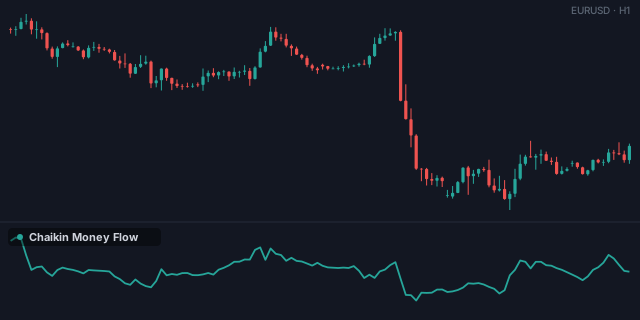
Trend confirmation: wire bars into CMF and require it above zero (buying pressure) via a Greater Than against 0, combined with your long trigger through an And gate into a Tester — so you only buy when money flow agrees. Backtest in the Tester.
Tips & gotchas
- Reads close-within-range × volume — where price settles in the bar is the core idea.
- Zero is the pivot. Above = accumulation, below = distribution; the cross is a slow shift signal.
- Divergence warns of drying flow — its best predictive use.
- A gap bar can mislead it — CMF uses the bar's own range, so a big gap (close inside a small range) can distort a single reading.
Related blocks
Inputs
| Socket | Type | What to wire in |
|---|---|---|
| Bars | bars |
Price bars |
Outputs
| Output | Type | Plots as | Description |
|---|---|---|---|
| CMF | series |
Line · sub-pane | CMF (−1..+1) |
Parameters
| Parameter | Type | Default | What it does |
|---|---|---|---|
| Period | number · 2–200 | 20 |
|
| Line color | colour | #26a69a |
Reference auto-generated from the block catalog · category Indicators.