Awesome Oscillator
Indicators · Momentum
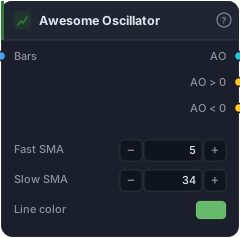
Bill Williams' Awesome Oscillator — SMA(hl2, 5) − SMA(hl2, 34).
The Awesome Oscillator (AO), one of Bill Williams's tools, is a beautifully simple momentum gauge: it compares a short-term average of price against a longer-term one and plots the gap as a zero-centred histogram. Above zero, short-term momentum is outrunning the longer trend (bullish); below zero, it's lagging (bearish). It cuts straight to whether momentum is building or fading, with no thresholds to tune.
How it works
AO is SMA(median price, 5) − SMA(median price, 34), where median price is (high + low) / 2. The Fast SMA (5) captures recent momentum, the Slow SMA (34) the broader drift, and their difference oscillates around a zero line in a sub-pane. The block also exposes plain AO > 0 and AO < 0 signals. Because it's built from the bar's midpoint rather than the close, it reflects the whole bar's positioning, not just where it settled.
When to use it
Use AO for momentum direction and divergence. The simplest read is the zero-line cross — momentum flipping bullish or bearish. Williams also described the "saucer" (a shift in momentum on the same side of zero) and "twin peaks" (a divergence pattern) as faster entries. As a zero-centred oscillator it's excellent for spotting when a trend's momentum is quietly fading before price turns — but like all momentum tools it's a confirmer, weak in dead ranges where it knots around zero.
Example
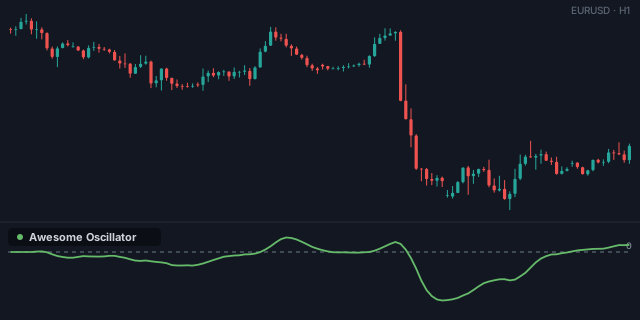
A momentum-confirmed entry: wire bars into the Awesome Oscillator and require AO > 0 alongside a trend trigger through an And gate into a Tester, so you only buy when momentum is genuinely positive. Combine with a 200-EMA bias for direction, protect with a Tester, and backtest in the Tester.
Tips & gotchas
- Zero is the line that matters. No overbought/oversold thresholds — it's all relative to zero.
- Built on (high+low)/2, not close — it reads the bar's midpoint, so it can differ from close-based oscillators.
- Divergence and zero-cross are the staples; the saucer/twin-peaks patterns are faster but need a discretionary eye.
- Flat near zero = no trade. In a range it offers little; pair with a trend filter.
- Pairs with the Accelerator Oscillator, which measures AO's acceleration for an even earlier read.
Related blocks
Inputs
| Socket | Type | What to wire in |
|---|---|---|
| Bars | bars |
Price bars |
Outputs
| Output | Type | Plots as | Description |
|---|---|---|---|
| AO | series |
Histogram · sub-pane | Awesome Oscillator value |
| AO > 0 | signal |
— | True while AO > 0 |
| AO < 0 | signal |
— | True while AO < 0 |
Parameters
| Parameter | Type | Default | What it does |
|---|---|---|---|
| Fast SMA | number · 1–100 | 5 |
|
| Slow SMA | number · 2–400 | 34 |
|
| Histogram colors | choice (Green / Red, Blue / Orange, Teal / Magenta, Lime / Crimson, Mono) |
Green / Red |
Chart guides
This indicator draws reference level(s): level.
Reference auto-generated from the block catalog · category Indicators.