Momentum
Indicators · Momentum
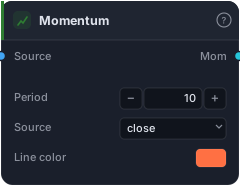
Price difference between current bar and N bars ago.
Momentum is the simplest oscillator there is: today's price minus the price N bars ago. That's it — the raw distance price has travelled over a fixed look-back. Positive means price is higher than it was; negative means lower; and the size tells you how fast. It oscillates around a zero line, and despite its bluntness it's a surprisingly honest read of whether a move is accelerating or running out of steam.
How it works
For each bar the block subtracts the Source value from Period bars ago (default 10) from the current Source value: Momentum = Price_now − Price_(now − Period). No averaging, no smoothing, no scaling — which is the point. Because it's a raw price difference, its magnitude is in the instrument's own price units, so "big" is relative to the asset (this is what separates it from ROC, which expresses the same idea as a percentage and is comparable across markets).
The Source defaults to close but can be any price or blend, or another indicator's series wired into the input. The one output plots in a sub-pane, swinging above and below zero.
When to use it
Use Momentum as a confirmation and divergence tool rather than a standalone trigger. A reading firmly above zero confirms an uptrend has thrust; a fade toward zero warns the move is decelerating before price actually turns. Its best signal is divergence — price making a fresh high while Momentum makes a lower high says the trend is tiring. The zero-line cross is a crude but usable trend-change cue. Because it's unsmoothed, it's noisy — most users feed it into a comparison or smooth it first.
Example
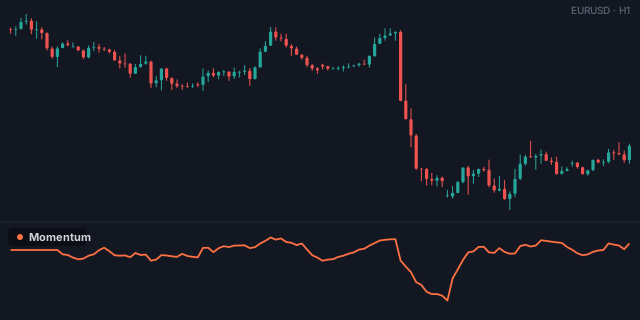
Momentum-confirmed entries: wire bars into Momentum and into your trend logic, then require Momentum to be above zero (via a Greater Than against 0) in an And gate alongside your entry trigger, routed to a Tester — so you only buy when price is genuinely accelerating up. Protect with a Tester and backtest in the Tester.
Tips & gotchas
- Raw difference, not percentage. Its scale is in price units, so it's not comparable across instruments — for that, reach for ROC.
- It's noisy by design. No smoothing means lots of small zero-line crosses; feed it into a comparison or an SMA to calm it down.
- Divergence is the edge. The cleanest use is spotting price/Momentum disagreement at extremes.
- Period sets the horizon. Short look-backs read fast, short-term thrust; longer ones read the bigger swing.
- Confirm, don't lead. Momentum lags the turn slightly — best as a filter on another signal, not the entry itself.
Related blocks
Inputs
| Socket | Type | What to wire in |
|---|---|---|
| Source | bars / series |
Price bars or any indicator series |
Outputs
| Output | Type | Plots as | Description |
|---|---|---|---|
| Mom | series |
Line · sub-pane | Price difference |
Parameters
| Parameter | Type | Default | What it does |
|---|---|---|---|
| Period | number · 1–200 | 10 |
|
| Source | choice (close, open, high, low, hl2, hlc3, ohlc4) |
close |
|
| Line color | colour | #ff7043 |
Reference auto-generated from the block catalog · category Indicators.