RSI
Indicators · Oscillators
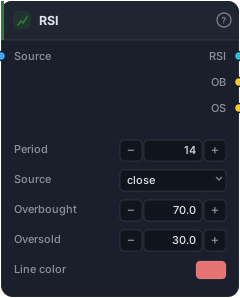
Relative Strength Index — 0..100 momentum oscillator.
RSI is the classic momentum gauge: a single 0–100 line that tells you whether price has been pushing up or down too hard, too fast. When a market rallies relentlessly the RSI climbs toward 100; when it sells off it sinks toward 0. Traders reach for it to spot stretched, exhausted moves — the "this can't keep going" feeling — without eyeballing it. You get the line plus two ready-made boolean outputs (overbought / oversold) so you don't have to bolt on a Constant and a Comparison every time.
How it works
For each bar, RSI looks at the change in your chosen Source price (close by default) versus the prior bar. Gains and losses are separated, then each is smoothed with Wilder's RMA over the Period (an EMA with alpha = 1/period, not a plain SMA — substituting a simple average gives different numbers). The relative strength is RS = avg_gain / avg_loss, and the final value is:
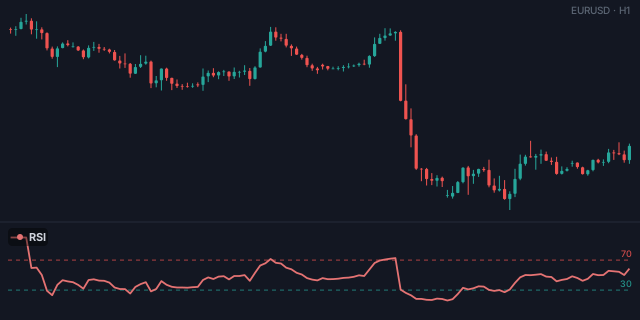
A flat-up series with no losses yields RSI = 100. The OB output fires true when RSI rises above Overbought (default 70), and OS fires when RSI drops below Oversold (default 30). The same two thresholds are drawn as dashed guide lines on the indicator's sub-pane.
When to use it
RSI shines in range-bound or mean-reverting markets — fade the extremes, buy the dip near oversold, sell the rip near overbought. It's also great as a filter: confirm a trend entry only when momentum agrees. Be careful in strong trends: RSI can sit pinned above 70 (or below 30) for a long time, and naively shorting "overbought" in a rip is how accounts bleed. In trends, raising thresholds (e.g. 80/20) or using RSI only for pullback timing works better.
Example
A simple mean-reversion long: wire bars into RSI, take the OS output into a Cross Above / entry trigger so you go long the moment RSI exits oversold, and feed the result into a Tester. Add a higher-timeframe SMA as a regime filter so you only take dips while the broader trend is up. Pair with an ATR-based stop for honest risk.
Tips & gotchas
- No lookahead — RSI uses only past and current bars, so it's safe for backtests; just don't compare this bar's fresh RSI against a level you also computed with future data elsewhere.
- Period drives sensitivity — a short period (7) whips around and triggers constantly; a long one (21+) is smoother but laggier. 14 is the original Wilder default for a reason.
- Overbought ≠ sell signal. In a trend, "overbought" means strong, not over. Use a trend filter before fading extremes.
- Divergence is the real edge — price making a new high while RSI doesn't often precedes reversals; consider RSI Divergence for that pattern directly.
- Source matters — switching to
hlc3orohlc4smooths noisy, gappy instruments slightly versus rawclose.
Related blocks
Inputs
| Socket | Type | What to wire in |
|---|---|---|
| Source | bars / series |
Price bars or any indicator series |
Outputs
| Output | Type | Plots as | Description |
|---|---|---|---|
| RSI | series |
Line · sub-pane | RSI value (0..100) |
| OB | signal |
— | True when RSI is above the overbought threshold |
| OS | signal |
— | True when RSI is below the oversold threshold |
Parameters
| Parameter | Type | Default | What it does |
|---|---|---|---|
| Period | number · 2–200 | 14 |
|
| Source | choice (close, open, high, low, hl2, hlc3, ohlc4) |
close |
|
| Overbought | number · 50.0–100.0 | 70.0 |
|
| Oversold | number · 0.0–50.0 | 30.0 |
|
| Line color | colour | #e57373 |
Chart guides
This indicator draws reference level(s): overbought, oversold.
Reference auto-generated from the block catalog · category Indicators.