Stochastic
Indicators · Oscillators

Stochastic oscillator (%K and %D lines, 0..100).
The Stochastic oscillator asks one sharp question: where does this bar close inside its recent range? If price keeps closing near the top of its range, momentum is up; near the bottom, momentum is down. It bounces between 0 and 100, so it's a natural overbought/oversold meter — and because it reads position within range rather than raw price, it often turns ahead of price itself.
How it works
Over the %K period (default 14) the block finds the highest high and lowest low, then plots raw %K as (close − lowest low) / (highest high − lowest low) × 100. That raw line is jumpy, so Smoothing (default 3) averages it — a smoothing of 1 gives you the classic "fast" stochastic, higher values the "slow" one. The %D line is then an SMA of %K over the %D period (default 3); %D is the slower signal line that %K crosses.
Two reference levels mark the extremes — Overbought (default 80) and Oversold (default 20) — drawn as dashed guides in the sub-pane. The block also exposes plain OB and OS signals that fire true when %K pushes past those thresholds, so you can wire conditions without rebuilding the comparison.
When to use it
Stochastic is at its best in ranging, mean-reverting markets: buy as %K turns up out of oversold, sell as it rolls over from overbought. The %K-crosses-%D event inside an extreme zone is the classic trigger. In a strong trend it will sit pinned in overbought (or oversold) for a long time — there, treat extremes as continuation, not reversal, or filter them out entirely. Divergence between price and %K is a high-quality warning of exhaustion.
Example
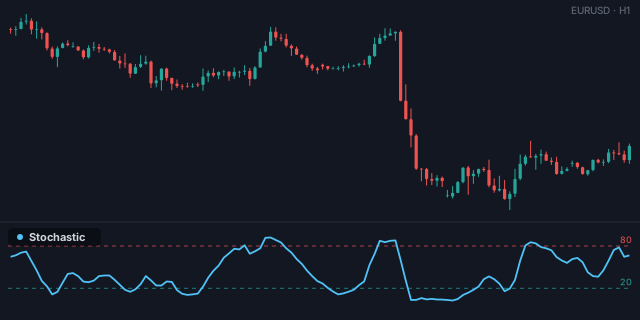
A range fade: wire bars into Stochastic, take the OS output and combine it with a %K-turning-up condition through a Crosses Above on the %K/%D pair, then route to a Tester. Keep it honest by only trading when ADX / DMI shows a weak trend (a real range), and protect with a Tester below the swing low. Backtest in the Tester.
Tips & gotchas
- Fast vs slow is the Smoothing knob. Smoothing
1is twitchy and signal-rich but noisy;3+ is calmer and more reliable. Most traders run the slow version. - Don't fade a trend. "Embedded" stochastic — stuck above 80 for many bars — means strong momentum, not a top. Gate extremes with a trend filter.
- Tune the thresholds to the asset. 80/20 is convention; volatile assets may justify 90/10 to cut false stretches.
- %K-%D cross > raw threshold. Entering on the lines crossing inside a zone beats entering the instant the zone is touched.
- Cousin to Stochastic RSI — that one runs this same math on RSI instead of price for an even faster, more sensitive read.
Related blocks
Inputs
| Socket | Type | What to wire in |
|---|---|---|
| Bars | bars |
Price bars |
Outputs
| Output | Type | Plots as | Description |
|---|---|---|---|
| %K | series |
Line · sub-pane | %K line (0..100) |
| %D | series |
Line · sub-pane | %D line (smoothed %K) |
| OB | signal |
— | %K above threshold |
| OS | signal |
— | %K below threshold |
Parameters
| Parameter | Type | Default | What it does |
|---|---|---|---|
| %K period | number · 1–200 | 14 |
|
| %D period | number · 1–50 | 3 |
|
| Smoothing | number · 1–50 | 3 |
1 = fast stochastic |
| Overbought | number · 50.0–100.0 | 80.0 |
|
| Oversold | number · 0.0–50.0 | 20.0 |
|
| %K color | colour | #4fc3f7 |
|
| %D color | colour | #ffb74d |
Chart guides
This indicator draws reference level(s): overbought, oversold.
Reference auto-generated from the block catalog · category Indicators.