Stochastic RSI
Indicators · Oscillators
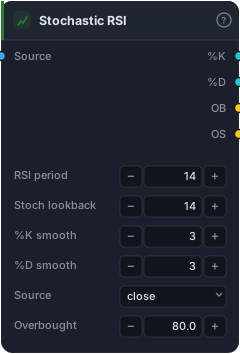
Stochastic oscillator applied to RSI (0..100, % form).
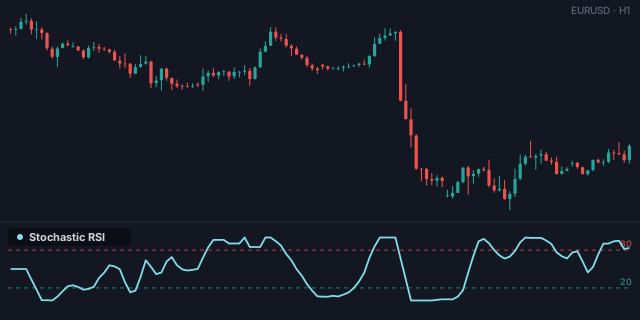
Stochastic RSI is an oscillator of an oscillator: it applies the Stochastic calculation to RSI instead of to price. The point is sensitivity. Plain RSI can sit in the middle of its range for ages; running a Stochastic over it stretches every RSI move out to the full 0–100 scale, so you get far more frequent, sharper overbought/oversold signals. It's the high-strung, fast-twitch cousin of the RSI.
How it works
First the block computes RSI of the Source over the RSI period (default 14). Then it runs a Stochastic over that RSI series across the Stoch lookback (default 14): where does current RSI sit between its own recent high and low? That raw value is smoothed into %K (over %K smooth, default 3) and %D is an SMA of %K (over %D smooth, default 3). The result swings 0–100, far more often hitting the Overbought (default 80) and Oversold (default 20) extremes than RSI itself would. Both lines plot in a sub-pane.
When to use it
Use Stochastic RSI when ordinary RSI feels too slow and you want earlier, more frequent signals — chiefly in ranges, fading the extremes, with the %K/%D cross inside a zone as the trigger. The cost of that sensitivity is noise: it whipsaws readily and hits 0 or 100 often, so it is not a standalone system. Pair it with a trend filter and treat extreme readings as alerts to look closer, not automatic trades.
Example
A fast range fade: wire bars into Stochastic RSI, take the OS signal with a %K-crosses-%D confirmation via Crosses Above, and route to a Tester — but gate it with ADX / DMI showing a weak trend so the sensitivity doesn't bury you in false signals during trends. Backtest in the Tester.
Tips & gotchas
- Sensitive by design — and noisy. It hits 0/100 constantly; never trade it naked.
- It's two lookbacks deep. RSI period and Stoch lookback both shape it; start at 14/14 and change one at a time.
- %K-%D cross beats the raw threshold for timing inside a zone.
- Trend filter is mandatory — in a trend it pins at an extreme and every fade fails.
Related blocks
Inputs
| Socket | Type | What to wire in |
|---|---|---|
| Source | bars / series |
Price bars or any indicator series |
Outputs
| Output | Type | Plots as | Description |
|---|---|---|---|
| %K | series |
Line · sub-pane | %K line |
| %D | series |
Line · sub-pane | %D line |
| OB | signal |
— | %K above threshold |
| OS | signal |
— | %K below threshold |
Parameters
| Parameter | Type | Default | What it does |
|---|---|---|---|
| RSI period | number · 2–200 | 14 |
|
| Stoch lookback | number · 2–200 | 14 |
|
| %K smooth | number · 1–50 | 3 |
|
| %D smooth | number · 1–50 | 3 |
|
| Source | choice (close, open, high, low, hl2, hlc3, ohlc4) |
close |
|
| Overbought | number · 50.0–100.0 | 80.0 |
|
| Oversold | number · 0.0–50.0 | 20.0 |
|
| %K color | colour | #80deea |
|
| %D color | colour | #ff8a65 |
Chart guides
This indicator draws reference level(s): overbought, oversold.
Reference auto-generated from the block catalog · category Indicators.