Cumulative Volume Delta
Indicators · Volume
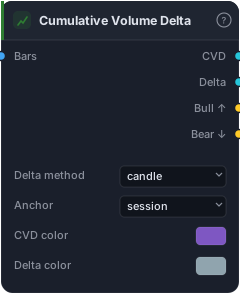
Cumulative Volume Delta — running buy/sell volume imbalance (bar-approximated).
Cumulative Volume Delta (CVD) tracks the running tug-of-war between buyers and sellers. "Delta" is the difference between buying volume and selling volume on each bar; CVD accumulates it into a running line. When aggressive buyers dominate, CVD climbs; when sellers do, it falls. It's a staple of order-flow trading because it shows who is actually winning beneath the price — and its disagreements with price (divergence) are some of the most respected signals in the discipline.
How it works
True delta needs tick-by-tick trade data, so on bar data the block approximates it. The Delta method chooses how: candle infers buy/sell split from where the bar closed in its range (a bullish bar counts as net buying), while proportional apportions volume by the bar's structure. Each bar's signed volume is plotted as the Delta histogram, and the CVD line accumulates it. The running sum resets at the Anchor — session, week, or all — just like VWAP. Zero-line crosses fire Bull ↑ / Bear ↓ signals.
Be clear-eyed about the approximation: without real tick data this is a model of order flow, not the true print-by-print delta a futures order-flow terminal shows. It's directionally useful, especially on instruments with honest volume, but it's an estimate.
When to use it
Use CVD for order-flow confirmation and divergence. Rising CVD confirming a price rally means real buying is behind it; CVD falling while price grinds higher (bearish divergence) warns the rally is being sold into and may fail — a classic absorption/exhaustion read. Pick the anchor to match your horizon (session for intraday). It's most trustworthy where volume is real (futures, crypto, stocks) and weakest on thin spot forex.
Example
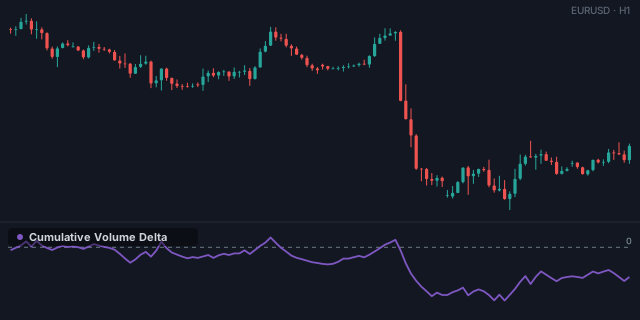
Spot a failing rally: wire bars into CVD with session anchor, and use a price-up-but-CVD-down condition as a caution flag — or trade the cleaner case, requiring CVD rising (via its zero-cross Bull ↑) alongside your long trigger through an And gate into a Tester. Backtest in the Tester.
Tips & gotchas
- It's an approximation on bars. Without tick data it models delta from bar shape — directional, not the true order-flow print.
- Divergence is the marquee use — price up, CVD down = selling into strength.
- Match the anchor to your timeframe, like VWAP.
- Best where volume is honest — futures/crypto/stocks over thin spot FX.
Related blocks
Inputs
| Socket | Type | What to wire in |
|---|---|---|
| Bars | bars |
Price bars |
Outputs
| Output | Type | Plots as | Description |
|---|---|---|---|
| CVD | series |
Line · sub-pane | Cumulative volume delta |
| Delta | series |
Histogram · sub-pane | Per-bar signed volume |
| Bull ↑ | signal |
Signal arrows | CVD crosses above zero |
| Bear ↓ | signal |
Signal arrows | CVD crosses below zero |
Parameters
| Parameter | Type | Default | What it does |
|---|---|---|---|
| Delta method | choice (candle, proportional) |
candle |
|
| Anchor | choice (session, week, all) |
session |
Where the cumulative delta resets |
| CVD color | colour | #7e57c2 |
|
| Histogram colors | choice (Green / Red, Blue / Orange, Teal / Magenta, Lime / Crimson, Mono) |
Green / Red |
Chart guides
This indicator draws reference level(s): Zero.
Reference auto-generated from the block catalog · category Indicators.