Latch
Flow · State
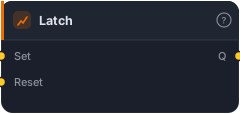
SR-flip-flop: once set fires true, output stays true until reset fires. If both fire on the same bar, reset wins (safe default — 'reset has priority' avoids stuck-on bugs). Useful for 'arm a trade after structural break, hold the green light until the break is invalidated'.
Latch is a memory cell. Once a Set signal fires, its output stays true — and keeps staying true, bar after bar — until a Reset signal fires. It's the electronics SR flip-flop brought to trading, and it solves a problem pure per-bar logic can't: holding a state between events. "Once structure breaks bullish, stay armed for longs until that break is invalidated" is a Latch, not a comparison.
How it works
The block has a Set input that flips the latch on and an optional Reset input that flips it off. The Q output holds the current latched state: true from the bar Set fired until the bar Reset fires, then false until Set fires again. If both fire on the same bar, Reset wins — a deliberate safe default, because "reset has priority" prevents stuck-on bugs where a latch can never clear. Without a Reset wired, the latch stays on forever after the first Set.
When to use it
Use Latch whenever a condition should arm a state that persists until something cancels it. The canonical smart-money case: a bullish Market Structure break arms a long bias (Set), and you hold that green light — taking pullback entries within it — until a bearish break invalidates it (Reset). It's also how you implement "stay in setup mode after a Liquidity Sweep until price leaves the zone." Anywhere you need "remember that X happened until Y happens," Latch is the block.
Example
Arm longs after a structure break: wire a bullish Market Structure BOS into Set and a bearish CHoCH into Reset; the Q output is true for the whole bullish phase. And Q with your pullback trigger into a Tester, so you only take longs while the bullish structure holds. Backtest in the Tester.
Tips & gotchas
- It remembers between events — the thing per-bar comparisons can't do.
- Reset wins ties — a safe default that avoids stuck-on latches.
- No Reset = on forever after the first Set; wire a Reset unless that's truly intended.
- Pair Q with a trigger via And — the latch sets the context, the trigger sets the timing.
Related blocks
Inputs
| Socket | Type | What to wire in |
|---|---|---|
| Set | signal |
Pulses the latch on. |
| Reset (optional) | signal |
Pulses the latch off. Optional — without it, the latch stays on forever after first set. |
Outputs
| Output | Type | Plots as | Description |
|---|---|---|---|
| Q | signal |
Signal arrows | Latched state. |
Reference auto-generated from the block catalog · category Flow.