Minimum
Math · Arithmetic
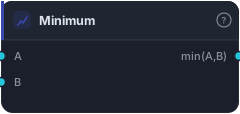
Element-wise minimum of two series — the smaller of A and B at each bar. Use for 'the nearer take-profit', 'cap a level'. NaN if either input is NaN.
Minimum takes two series and, bar by bar, returns whichever is smaller. It's the element-wise "the lesser of A and B" — the block you use to cap a level, take the nearer of two targets, or keep the more conservative of two readings.
How it works
Each bar it outputs min(A, B). Both inputs are series, so either can be price, an indicator, or a constant. If either input is NaN on a bar, the result is NaN. No parameters — behaviour is set entirely by the inputs. Lookahead-free.
When to use it
Use it whenever "never more than X" is the rule: cap a take-profit at a structural resistance so you don't target beyond it, take the nearer of two exit levels, or hold a size multiplier under a ceiling. With Maximum it's the pair you use to bound a value from both directions.
Example
Nearer take-profit: compute an ATR-based target and a structure-based target, then feed both into Minimum so the trade exits at whichever is closer — a more conservative, higher-hit-rate TP. Wire it into the Tester's take-profit input.
Tips & gotchas
- Element-wise, per bar — not the running minimum over time (that's Running Min Since).
- NaN in either input → NaN out.
- Pair with Maximum to bound both sides, or just use Clamp.
Related blocks
Inputs
| Socket | Type | What to wire in |
|---|---|---|
| A | series / bars |
First operand. BARS input uses close. |
| B | series / bars |
Second operand. BARS input uses close. |
Outputs
| Output | Type | Plots as | Description |
|---|---|---|---|
| min(A,B) | series |
Line · sub-pane | Per-bar element-wise minimum. |
Reference auto-generated from the block catalog · category Math.