Parabolic SAR
Indicators · Trend
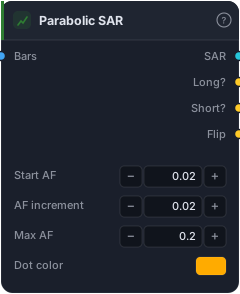
Wilder's stop-and-reverse trailing-stop system.
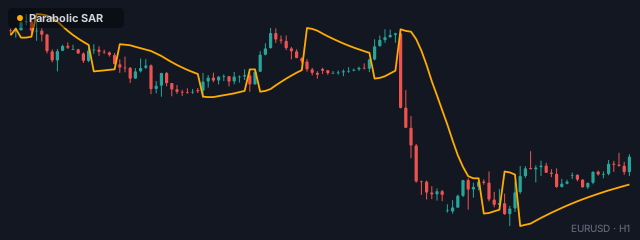
Parabolic SAR ("Stop And Reverse"), another Welles Wilder creation, is a trailing-stop system that plots a dotted line which hops from below price (in an uptrend) to above price (in a downtrend). The dots tighten toward price as a trend matures, so the SAR doubles as a ready-made trailing stop and a trend-direction signal: whichever side the dots are on tells you the trend, and when price touches them, the trend flips. It's designed for one thing above all — riding trends and getting you out when they end.
How it works
Each bar the SAR steps toward price by an acceleration factor (AF) that starts at Start AF (0.02) and grows by AF increment (0.02) every time the trend makes a new extreme, up to Max AF (0.2). So the longer and stronger a trend runs, the faster the dots accelerate toward price — locking in more profit. When price crosses the SAR, the system reverses: the dots jump to the other side and the AF resets. The block exposes the SAR line, Long?/Short? state signals, and a Flip signal on the bar the trend reverses.
When to use it
Parabolic SAR is a trend-riding and exit tool. It excels in sustained, directional moves — staying with the trend and trailing a tightening stop. Its weakness is notorious: in sideways chop it flips back and forth constantly, generating a stream of small losses. So it's best used with a trend filter (only act on flips when a trend exists) or purely as a trailing-stop mechanism layered on top of another entry system. The three AF settings control how tightly it trails — higher Max AF = tighter, quicker stops.
Example
A trailing exit on a filtered trend: gate entries with ADX / DMI, enter long on a Parabolic SAR Flip to the upside (combined via an And gate into a Tester), and use the SAR line itself as the trailing stop through a Tester. Backtest with and without the ADX gate in the Tester to see the chop it removes.
Tips & gotchas
- It's a stop system first. Its best job is trailing exits; as a standalone entry it whipsaws in ranges.
- Range = death by flips. A trend filter (ADX / DMI, Choppiness) is near-mandatory.
- Max AF tunes the trail. Higher = tighter stops that lock profit but get tapped sooner; lower = looser, more room.
- The dots accelerate with trend age — late in a big move the stop is very close.
Related blocks
Inputs
| Socket | Type | What to wire in |
|---|---|---|
| Bars | bars |
Price bars |
Outputs
| Output | Type | Plots as | Description |
|---|---|---|---|
| SAR | series |
Line | SAR value (price scale) |
| Long? | signal |
— | True while trend is up |
| Short? | signal |
— | True while trend is down |
| Flip | signal |
Signal arrows | True on bars where SAR flipped |
Parameters
| Parameter | Type | Default | What it does |
|---|---|---|---|
| Start AF | number · 0.001–0.5 | 0.02 |
|
| AF increment | number · 0.001–0.5 | 0.02 |
|
| Max AF | number · 0.01–1.0 | 0.2 |
|
| Dot color | colour | #ffab00 |
Reference auto-generated from the block catalog · category Indicators.