Choppiness Index
Indicators · Volatility
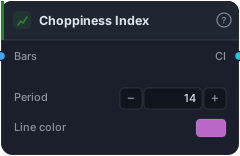
Trend-vs-chop regime detector (0..100).
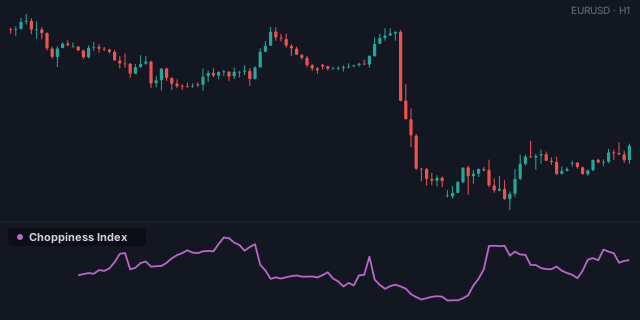
The Choppiness Index does one job and does it well: it tells you whether the market is trending or chopping — without saying which direction. It's a pure regime detector on a 0–100 scale. High readings mean price is coiling sideways, winding back and forth (choppy); low readings mean it's travelling directionally (trending). It's the perfect switch for turning trend logic and mean-reversion logic on and off at the right times.
How it works
Over the Period (default 14) the index compares the sum of each bar's range against the total range of the whole window. When price trends, it covers a lot of net distance efficiently, so the total range is large relative to the summed bar ranges — and the index reads low. When price chops, it travels a long, winding path but ends up near where it started, so the summed ranges dwarf the net range — and the index reads high. The result is a single 0–100 line in a sub-pane; readings above ~61.8 typically mean chop, below ~38.2 mean trend (the Fibonacci-derived conventional bounds).
When to use it
Use Choppiness as a regime filter, never as a directional signal. Below ~38 it's safe to deploy trend-following tools (breakouts, Supertrend, moving-average crosses); above ~62, switch to mean-reversion (RSI/Stochastic fades) and turn breakouts off. It's closely related to ADX / DMI, but inverted in feel — high Choppiness ≈ low ADX. A falling Choppiness from a high base often marks a trend being born.
Example
Gate a breakout: wire bars into Choppiness and into your breakout logic, then require Choppiness below a threshold (trending) via a Less Than, combined with the breakout through an And gate into a Tester — so you only trade breakouts when the market isn't chopping. Backtest with and without the gate in the Tester to see the fakeouts it removes.
Tips & gotchas
- Directionless. It says trend-vs-chop, not up-vs-down — read direction elsewhere.
- ~61.8 / ~38.2 are the conventional bounds, drawn from Fibonacci; tune to taste.
- Inverse cousin of ADX / DMI — high Choppiness ≈ weak trend.
- A switch, not a trigger — its job is enabling the right logic for the regime.
Related blocks
Inputs
| Socket | Type | What to wire in |
|---|---|---|
| Bars | bars |
OHLC bars (high/low/close required) |
Outputs
| Output | Type | Plots as | Description |
|---|---|---|---|
| CI | series |
Line · sub-pane | Choppiness Index (high = sideways, low = trending) |
Parameters
| Parameter | Type | Default | What it does |
|---|---|---|---|
| Period | number · 2–500 | 14 |
Lookback window |
| Line color | colour | #ba68c8 |
Reference auto-generated from the block catalog · category Indicators.