Premium / Discount
Structure · Smart Money
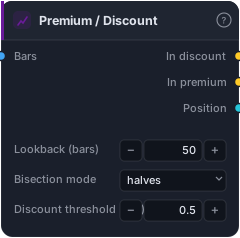
Bisect the rolling range and emit per-bar premium / discount signals. Buy from discount, sell from premium — the SMC entry-timing primitive.
Premium/Discount applies a single, powerful idea from smart-money trading: buy cheap, sell expensive — relative to the current range. It takes the recent trading range, splits it, and tells you whether price is currently in the discount (lower) zone, where longs are "on sale," or the premium (upper) zone, where shorts get a better price. It's the entry-timing primitive that keeps you from buying at the top of a range or shorting at the bottom — a discipline filter as much as a signal.
How it works
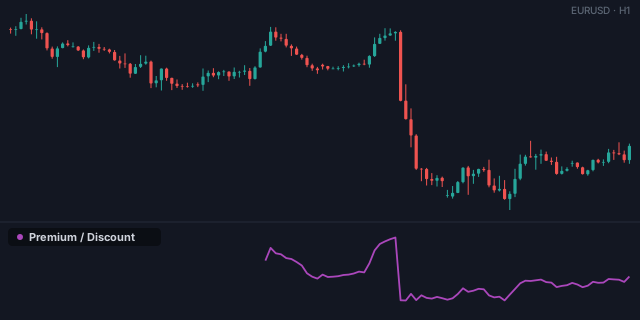
Over the Lookback window (default 50) the block measures the rolling high and low to define the range, then reports where the current close sits within it as a normalised Position from 0 (at the rolling low) to 1 (at the rolling high), plotted in a sub-pane. How it splits the range depends on Bisection mode: halves puts the boundary at the midpoint (discount = bottom 50%, premium = top 50%); thirds carves out a neutral equilibrium band in the middle (discount = bottom third, premium = top third, with no signal in between). The In discount and In premium signals fire accordingly (drawn as arrows). Position is NaN until the lookback window fills.
When to use it
Use Premium/Discount as a location filter on your entries, not a standalone signal. In a smart-money workflow it answers "is this a good price to act?": after structure (Market Structure) gives you a bullish bias, you only take longs while price is in discount — never chasing into premium. The thirds mode is stricter (it ignores the muddy middle), which suits traders who want only clear premium/discount extremes. The equilibrium (50% / midpoint) is itself a meaningful level price often reacts to.
Example
Discount-only longs: wire bars into Premium/Discount and require In discount alongside a bullish Market Structure bias and a trigger — combine through an And gate into a Tester, so you only buy when structure is up and price is cheap within its range. Place the Tester below the range low and backtest in the Tester.
Tips & gotchas
- Buy discount, sell premium. It's a price-location discipline — it stops you chasing.
thirdsadds an equilibrium dead-zone — stricter, only the clear extremes signal;halvesalways picks a side.- It's a filter, not direction. Pair with structure for bias — discount in a downtrend is still a falling knife.
- Lookback defines the range — short for intraday swings, long for the bigger picture; match it to the move you're trading.
Related blocks
Inputs
| Socket | Type | What to wire in |
|---|---|---|
| Bars | bars |
Price bars (uses high / low for the range, close for the position). |
Outputs
| Output | Type | Plots as | Description |
|---|---|---|---|
| In discount | signal |
Signal arrows | True when close is in the discount (lower) zone. |
| In premium | signal |
Signal arrows | True when close is in the premium (upper) zone. |
| Position | series |
Line · sub-pane | Normalised range position: 0 at the rolling low, 1 at the rolling high. NaN until the lookback window fills. |
Parameters
| Parameter | Type | Default | What it does |
|---|---|---|---|
| Lookback (bars) | number · 5–2000 | 50 |
Window size for the rolling high/low range. |
| Bisection mode | choice (halves, thirds) |
halves |
halves: 50/50 split — discount = bottom half, premium = top half. thirds: 33/66 split — discount = bottom third, premium = top third, equilibrium in the middle (signals are False there). |
| Discount threshold (0..1) | number · 0.0–1.0 | 0.5 |
Custom threshold — used only when mode is set via param or for advanced tuning. 0.5 = 50/50 halves; 0.33 = thirds. |
Reference auto-generated from the block catalog · category Structure.