RVGI
Indicators · Momentum
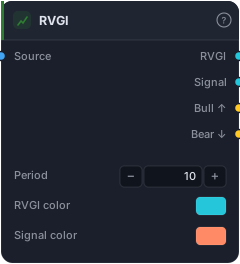
Relative Vigor Index — close-vs-open ratio against the bar range.
The Relative Vigor Index (RVGI) is built on a simple piece of market wisdom: in an uptrend, prices tend to close higher than they open, and in a downtrend they close lower than they open. RVGI measures that close-versus-open "vigour" relative to each bar's range and smooths it into an oscillator. When the vigour is positive and rising, bulls have the conviction; when negative, bears do. It's a momentum tool with a slightly different lens than price-change oscillators — it reads the character of each bar.
How it works
For each bar the block measures (close − open) against the bar's (high − low) range, then smooths it (a weighted average across recent bars) over the Period (default 10) to produce the RVGI line. A Signal line — a 4-bar symmetric weighted moving average of RVGI — provides the crossover trigger, and Bull ↑ / Bear ↓ fire when RVGI crosses it. Both plot in a sub-pane oscillating around zero.
When to use it
Use RVGI for momentum confirmation and crossover signals, particularly as a complement to price-based oscillators since it reads a different aspect of the bar (close-vs-open conviction rather than close-to-close change). The RVGI/Signal crossover is the entry trigger; divergence between RVGI and price flags a tiring move. It tends to work best in trending or swinging conditions and, like all oscillators, chops in flat ranges. Many traders pair it with a price oscillator and look for agreement.
Example
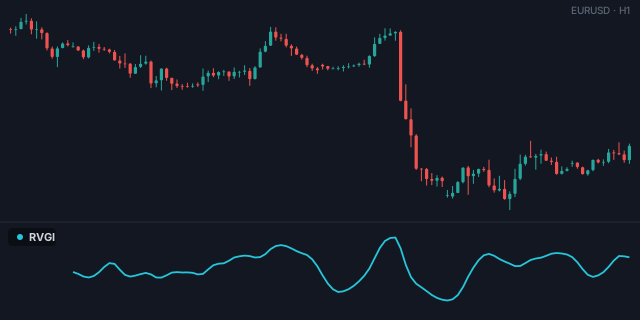
A vigour-confirmed entry: wire bars into RVGI and take the RVGI-crosses-Signal-up event via a Crosses Above into a Tester, confirmed by a MACD also bullish through an And gate (two different momentum lenses agreeing). Backtest in the Tester.
Tips & gotchas
- Reads close-vs-open conviction — a different lens than close-to-close oscillators.
- The RVGI/Signal cross is the trigger; divergence warns of exhaustion.
- Complements price oscillators — look for agreement between the two lenses.
- Chops in flat ranges like any oscillator — favour trending/swinging conditions.
Related blocks
Inputs
| Socket | Type | What to wire in |
|---|---|---|
| Source | bars |
Price bars (needs OHLC) |
Outputs
| Output | Type | Plots as | Description |
|---|---|---|---|
| RVGI | series |
Line · sub-pane | RVGI value |
| Signal | series |
Line · sub-pane | 4-bar SWMA of RVGI |
| Bull ↑ | signal |
Signal arrows | RVGI crosses above signal |
| Bear ↓ | signal |
Signal arrows | RVGI crosses below signal |
Parameters
| Parameter | Type | Default | What it does |
|---|---|---|---|
| Period | number · 2–200 | 10 |
|
| RVGI color | colour | #26c6da |
|
| Signal color | colour | #ff8a65 |
Reference auto-generated from the block catalog · category Indicators.