SMMA
Indicators · Moving Averages
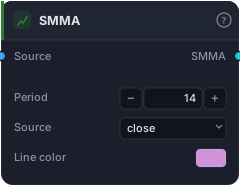
Smoothed (Wilder) Moving Average — slower than EMA.
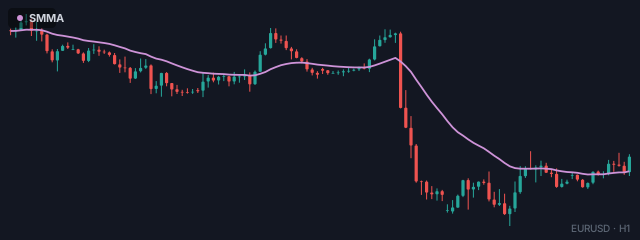
The SMMA (Smoothed Moving Average), also called Wilder's moving average, is the slow and steady member of the family. It deliberately gives up responsiveness in exchange for an exceptionally smooth, stable line that ignores short-term noise almost entirely. If the EMA is quick and the SMA is balanced, the SMMA is the calm one — it barely flinches at a single spike.
How it works
The SMMA is an exponential average with a gentle smoothing factor of 1 / Period (an EMA uses the larger 2 / (Period + 1), which is why the SMMA reacts more slowly for the same length). Each bar it nudges the previous value a small fraction of the way toward the new price. This is the exact smoothing Welles Wilder baked into RSI, ATR, and ADX / DMI, so the SMMA is really those indicators' internal averaging exposed as a standalone line. The Source defaults to close; the single output plots on the price pane in your Line color.
When to use it
Use the SMMA when you want a noise-resistant trend baseline — a slow line that defines the bigger picture and rarely gives false direction changes. It's well suited to longer-term bias filters and to smoothing jumpy inputs (wire a noisy series into it and the SMMA calms it right down). The downside is the obvious one: it lags more than an EMA, so it's a poor entry trigger and the last MA to react to a genuine reversal.
Example
A stable bias filter: wire bars into a Period 50 SMMA and only allow longs while price holds above it, combining that with a faster trigger through an And gate into a Tester. Because the SMMA changes direction rarely, your bias stays stable through the noise. Backtest in the Tester.
Tips & gotchas
- Slower than EMA on purpose. The
1/Periodfactor makes it the smoothest classic average — great for bias, poor for timing. - It's the engine inside Wilder's indicators. If you've ever used a 14-period RSI or ATR, you've used SMMA smoothing.
- Excellent noise filter for choppy series — feed an oscillator through it to clean up false crosses.
- Don't trade its crosses fast. Its lag means crossover signals arrive late; use it for context.
Related blocks
Inputs
| Socket | Type | What to wire in |
|---|---|---|
| Source | bars / series |
Price bars or any indicator series |
Outputs
| Output | Type | Plots as | Description |
|---|---|---|---|
| SMMA | series |
Line | Smoothed price series |
Parameters
| Parameter | Type | Default | What it does |
|---|---|---|---|
| Period | number · 2–500 | 14 |
Window length for Wilder's smoothing |
| Source | choice (close, open, high, low, hl2, hlc3, ohlc4) |
close |
Which price to smooth (used when bars are wired) |
| Line color | colour | #ce93d8 |
Color of the SMMA line on the chart |
Reference auto-generated from the block catalog · category Indicators.