TEMA
Indicators · Moving Averages
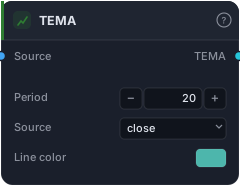
Triple Exponential Moving Average — further reduced lag vs DEMA.
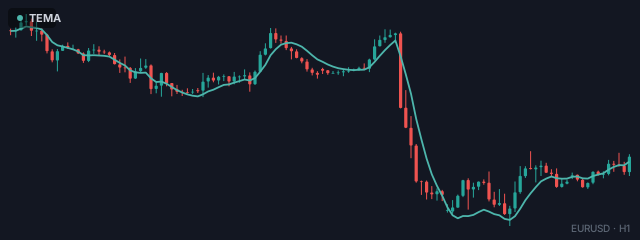
The TEMA (Triple Exponential Moving Average) takes the lag-cancellation idea behind the DEMA one step further. It's the most responsive of the classic EMA-family averages — the line practically rides on top of price, turning almost as soon as the market does. When you need a trend line that reacts now and you're willing to accept the noise that comes with speed, TEMA is the tool.
How it works
TEMA combines three layers of exponential smoothing: 3 × EMA − 3 × EMA(EMA) + EMA(EMA(EMA)) over the Period. Each extra EMA layer adds lag; the specific weighting of triple, minus triple-of-double, plus the triple-smoothed term cancels lag more aggressively than DEMA's two-layer version. The result hugs price tightly. The Source (default close) drives it, or wire a series in to smooth that. The single output plots on the price pane in your Line color.
When to use it
Use TEMA in fast, short-term systems where being late is the main enemy and you have other filters to handle the noise. It's excellent as the fast leg of a crossover or as a trigger line in a trending market. The flip side of its speed is sensitivity: in choppy conditions it whipsaws more than any other MA here, and its lag-cancellation can overshoot on spikes. It is a precision tool, not an all-weather one.
Example
A fast-but-filtered crossover: wire bars into a Period 15 TEMA (fast) and a Period 50 EMA (slow), cross them through a Crosses Above into a Tester, and gate the whole thing with ADX / DMI so the sensitive TEMA only acts in real trends. Backtest in the Tester and compare against the same system using an EMA fast leg.
Tips & gotchas
- Fastest of the family — and noisiest. Don't run it naked in ranges; it needs a trend or volatility filter.
- Great fast leg, poor slow leg. Use TEMA where responsiveness matters (the trigger), an SMA/EMA where stability matters (the bias).
- Overshoot is real in sharp reversals — expect the occasional early false turn.
- Step down to DEMA if TEMA feels too jumpy but EMA feels too slow.
Related blocks
Inputs
| Socket | Type | What to wire in |
|---|---|---|
| Source | bars / series |
Price bars or any indicator series |
Outputs
| Output | Type | Plots as | Description |
|---|---|---|---|
| TEMA | series |
Line | Triple EMA |
Parameters
| Parameter | Type | Default | What it does |
|---|---|---|---|
| Period | number · 2–500 | 20 |
|
| Source | choice (close, open, high, low, hl2, hlc3, ohlc4) |
close |
|
| Line color | colour | #4db6ac |
Reference auto-generated from the block catalog · category Indicators.