Hull MA
Indicators · Moving Averages
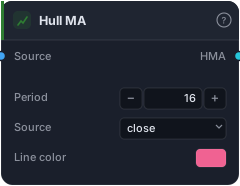
Hull Moving Average — aggressive low-lag smoothing.
The Hull Moving Average is the smoothness-and-speed paradox solved. Most averages force a choice: smooth but laggy, or responsive but noisy. The HMA manages to be both remarkably smooth and remarkably fast, so the line glides cleanly yet turns almost immediately when the trend changes. It's a favourite for visual trend reading and for systems that trade the slope of the trend rather than crossovers.
How it works
Alan Hull's trick is to fight lag with weighted averages of different lengths. The HMA computes WMA of (2 × WMA(Period/2) − WMA(Period)), then smooths that result with a final WMA of length √Period. The half-length WMA leads, the full-length WMA lags, and doubling the fast one minus the slow one cancels lag; the final short smoothing scrubs out the resulting noise. The Source defaults to close. The single output draws on the price pane in your Line color.
When to use it
The HMA shines as a trend-direction and slope tool: many traders ignore crossovers entirely and just trade in the direction the HMA is pointing, flipping bias when its slope changes colour. It's superb on higher timeframes for a clean read of the dominant trend. Because it's so responsive, it can overshoot and "hook" at turning points — use the confirmed slope change, not the first tick of it.
Example
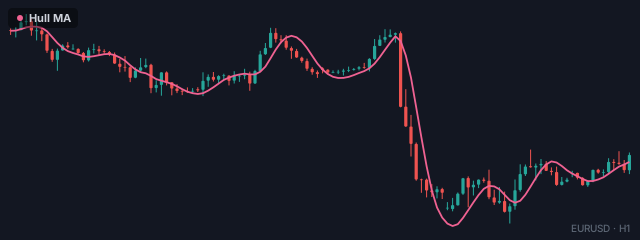
A slope-following bias: wire bars into a Period 16 HMA and define "trend up" as the HMA rising. Combine that bias with a pullback trigger (RSI turning up, say) through an And gate into a Tester. Use a faster HMA for the trigger and a slower one for bias if you prefer a pure-HMA system. Backtest in the Tester.
Tips & gotchas
- Trade the slope, not just the cross. The HMA's cleanest signal is its direction change — that's what it was built for.
- It overshoots and hooks at sharp reversals; wait for the turn to confirm over a bar or two.
- The period scales differently — because of the
√Periodfinal smoothing, an HMA16feels much faster than an SMA16. Don't compare lengths across MA types directly. - Beautiful on H4/D1. The smoothness really pays off on higher timeframes.
Related blocks
Inputs
| Socket | Type | What to wire in |
|---|---|---|
| Source | bars / series |
Price bars or any indicator series |
Outputs
| Output | Type | Plots as | Description |
|---|---|---|---|
| HMA | series |
Line | Hull moving average |
Parameters
| Parameter | Type | Default | What it does |
|---|---|---|---|
| Period | number · 4–500 | 16 |
|
| Source | choice (close, open, high, low, hl2, hlc3, ohlc4) |
close |
|
| Line color | colour | #f06292 |
Reference auto-generated from the block catalog · category Indicators.