ALMA
Indicators · Moving Averages
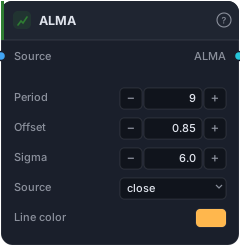
Arnaud Legoux Moving Average — Gaussian-weighted smoothing.
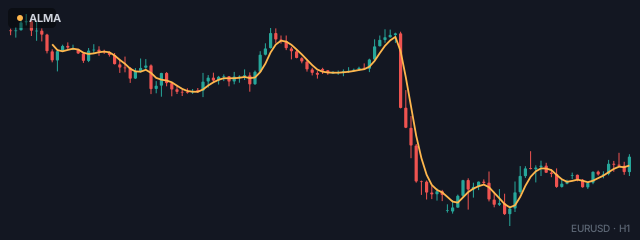
ALMA — the Arnaud Legoux Moving Average — is a moving average tuned for a clean, low-lag line with minimal noise. It applies a Gaussian (bell-curve) weighting across its window and lets you slide where the peak of that bell sits, trading lag against smoothness on a dial. Set up well, it tracks price almost as tightly as a fast MA but with the smooth, noise-free look of a slow one.
How it works
Instead of equal weights (SMA) or a one-sided exponential decay (EMA), ALMA lays a Gaussian curve over the Period window. Two knobs shape it. Offset (default 0.85) positions the peak of the bell: near 1 it emphasises the most recent bars (less lag, more responsive); near 0 it emphasises older bars (more lag, smoother). Sigma (default 6.0) sets the width of the bell: larger = smoother and more averaged, smaller = sharper and more reactive. Together they let you place the average exactly where you want on the lag/smoothness spectrum. The Source defaults to close; the output plots on the price pane in your Line color.
When to use it
Use ALMA when you want fine control over a trend line's character — it's the "tuneable" MA. A high offset gives you a responsive line for triggers; a lower offset gives you a stable bias line. Because it's smooth without much lag, it's a strong choice for crossover systems that suffer from EMA noise. The cost is two extra parameters to understand (and to not over-optimise).
Example
A low-noise crossover: wire bars into two ALMAs (a fast Period 9, offset 0.85 and a slower Period 21), cross them through a Crosses Above into a Tester, and gate with ADX / DMI. Compare the false-signal count against an EMA crossover in the Tester — ALMA's smoothness usually trims a few.
Tips & gotchas
- Offset = lag dial. Higher (toward 1) is more responsive; lower is smoother. Start at the 0.85 default.
- Sigma = smoothness dial. Bigger sigma, smoother line. 6 is a sensible middle.
- Two extra knobs = two extra ways to curve-fit. Tune deliberately and validate out-of-sample; don't chase the perfect offset/sigma on past data.
- Smooth but not magic — in a violent reversal it still lags; no average predicts.
Related blocks
Inputs
| Socket | Type | What to wire in |
|---|---|---|
| Source | bars / series |
Price bars or any indicator series |
Outputs
| Output | Type | Plots as | Description |
|---|---|---|---|
| ALMA | series |
Line | Gaussian-weighted smoothed price |
Parameters
| Parameter | Type | Default | What it does |
|---|---|---|---|
| Period | number · 2–500 | 9 |
Window length |
| Offset | number · 0.0–1.0 | 0.85 |
Peak position of the Gaussian (0 = oldest, 1 = newest) |
| Sigma | number · 0.1–50.0 | 6.0 |
Gaussian width — bigger = smoother |
| Source | choice (close, open, high, low, hl2, hlc3, ohlc4) |
close |
Which price to smooth (used when bars are wired) |
| Line color | colour | #ffb74d |
Reference auto-generated from the block catalog · category Indicators.