Kaufman Adaptive MA
Indicators · Moving Averages

Kaufman's Adaptive Moving Average — fast in trends, still in chop.
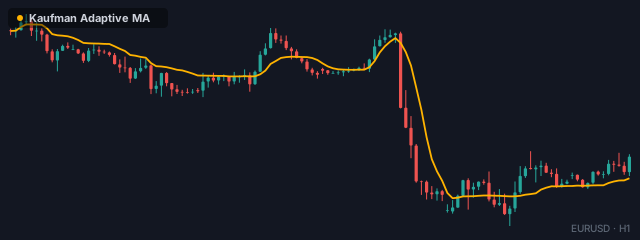
KAMA — Kaufman's Adaptive Moving Average — is a moving average that changes its own speed. When the market is trending cleanly it speeds up and tracks price closely; when the market is chopping sideways it slows almost to a standstill, refusing to be whipsawed by noise. It's one average that tries to give you the best of both worlds automatically, without you switching periods by hand.
How it works
KAMA's secret is the Efficiency Ratio: over the ER period (default 10) it measures how much net directional progress price made versus the total path it travelled. A straight, efficient move scores near 1; a noisy, back-and-forth move scores near 0. That score smoothly scales the smoothing constant between a Fast period (default 2 — quick) and a Slow period (default 30 — sluggish). High efficiency → fast smoothing → the line tracks price; low efficiency → slow smoothing → the line flattens out and waits. The Source defaults to close; the output plots on the price pane in your Line color.
When to use it
KAMA is built for markets that alternate between trending and ranging — which is most markets. Use it as a trend line that naturally sits still during the chop (cutting false signals) and engages during real moves. It's particularly nice as a dynamic stop or bias line: while it's flat, stand aside; when it tilts and starts moving, a trend is underway. It's not magic — in a sudden reversal it still has to "notice" the new efficiency before speeding up — but it whipsaws far less than a fixed-period MA.
Example
A self-filtering trend system: wire bars into KAMA and define entries as price crossing the KAMA while KAMA itself is sloping (i.e. it has sped up). Route the cross through a Crosses Above into a Tester. Because KAMA flattens in ranges, those false crosses largely disappear on their own. Backtest in the Tester against a fixed EMA.
Tips & gotchas
- It self-filters chop. The flat KAMA is your range filter — that's the whole point.
- Three periods to set, but ER period dominates. Leave fast/slow near 2/30 (Kaufman's defaults) and tune the ER period first.
- Flat KAMA = stand aside. Treat a horizontal KAMA as "no trade"; act when it tilts.
- Still lags real reversals slightly while it re-measures efficiency — adaptive isn't instant.
Related blocks
Inputs
| Socket | Type | What to wire in |
|---|---|---|
| Source | bars / series |
Price bars or any indicator series |
Outputs
| Output | Type | Plots as | Description |
|---|---|---|---|
| KAMA | series |
Line | Adaptive MA |
Parameters
| Parameter | Type | Default | What it does |
|---|---|---|---|
| ER period | number · 2–200 | 10 |
|
| Fast period | number · 1–100 | 2 |
|
| Slow period | number · 2–400 | 30 |
|
| Source | choice (close, open, high, low, hl2, hlc3, ohlc4) |
close |
|
| Line color | colour | #ffb300 |
Reference auto-generated from the block catalog · category Indicators.