McGinley Dynamic
Indicators · Moving Averages
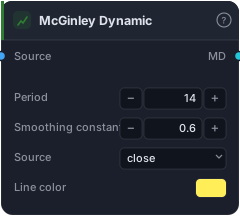
McGinley Dynamic — adaptive moving average that auto-tunes to market speed.
The McGinley Dynamic is a moving average designed to stay glued to price through changing market speeds. John McGinley built it to fix a complaint he had with ordinary averages: they're tuned to one fixed pace and fall behind when the market accelerates, then hug too tightly when it stalls. The McGinley line automatically speeds up in fast markets and eases off in slow ones, so it tracks price more faithfully without you touching the period.
How it works
It's a self-adjusting recursive average. Each bar it moves the previous value toward the new price by a step that depends on how far price has run relative to the line — when price pulls away quickly, the adjustment grows; when price drifts, it shrinks. The Period sets the baseline pace and the Smoothing constant (k) (default 0.6, McGinley's original) scales how aggressively it adapts — lower k makes it more responsive. The Source defaults to close; the output plots on the price pane in your Line color.
When to use it
Use the McGinley Dynamic as a trend line that needs less babysitting across regimes — it's a natural replacement for an EMA when you find yourself wishing the average would "keep up" in fast moves and "settle down" in quiet ones. It works well as a bias line and as a dynamic support/resistance level. It's adaptive, not psychic: it reduces lag, it doesn't remove it, and in a violent reversal it still takes a few bars to re-pace.
Example
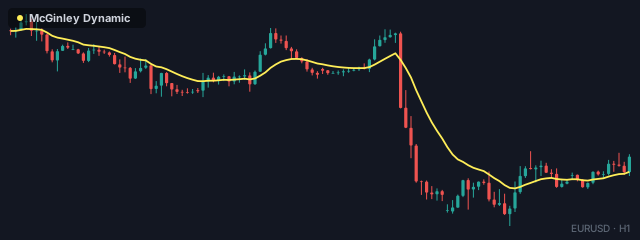
A low-maintenance bias: wire bars into a Period 14 McGinley Dynamic and only take longs while price holds above it, combining that with a trigger through an And gate into a Tester. Because the line auto-paces, the same settings stay reasonable across calm and volatile stretches. Backtest in the Tester versus an EMA bias.
Tips & gotchas
- k is the adaptiveness dial. Lower k = more responsive (and a bit noisier); the 0.6 default is the classic balance.
- Tracks better than EMA across regimes — that's its reason to exist; if your EMA keeps lagging fast moves, try this.
- Adaptive ≠ instant. It re-paces over a few bars, so it's still a confirmer, not a predictor.
- Don't over-tune k and period together — validate out-of-sample.
Related blocks
Inputs
| Socket | Type | What to wire in |
|---|---|---|
| Source | bars / series |
Price bars or any indicator series |
Outputs
| Output | Type | Plots as | Description |
|---|---|---|---|
| MD | series |
Line | McGinley Dynamic value |
Parameters
| Parameter | Type | Default | What it does |
|---|---|---|---|
| Period | number · 2–500 | 14 |
|
| Smoothing constant (k) | number · 0.1–2.0 | 0.6 |
McGinley's original is 0.6; lower = more responsive |
| Source | choice (close, open, high, low, hl2, hlc3, ohlc4) |
close |
|
| Line color | colour | #ffee58 |
Reference auto-generated from the block catalog · category Indicators.