Volume Oscillator
Indicators · Volume
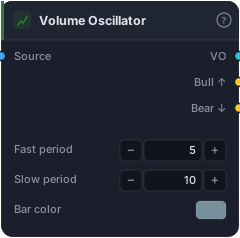
Volume Oscillator — percent diff between fast & slow volume MAs.
The Volume Oscillator strips volume down to one question: is participation rising or falling? It compares a fast and a slow moving average of volume and plots the percentage gap between them. When the fast volume average is above the slow one, recent volume is running hot (increasing participation); when below, it's cooling off. It's a clean way to confirm whether a price move has growing crowd support behind it — without staring at the raw, spiky volume histogram.
How it works
The block takes a Fast period (default 5) moving average of volume and a Slow period (default 10) moving average, then plots (fast − slow) / slow × 100 as a histogram around zero. Positive means short-term volume exceeds the longer baseline (expanding participation); negative means it's contracting. Bull ↑ / Bear ↓ signals fire on the zero-line cross. Because it's a percentage difference, the oscillator is comparable across instruments and over time, unlike raw volume. On forex it works on tick volume.
When to use it
Use the Volume Oscillator to confirm the conviction behind a move. Rising volume (oscillator climbing, positive) supporting a breakout or trend says participation is increasing — a healthy sign. Falling volume during a trend warns the move is running out of fuel and may be near exhaustion. It's purely a participation gauge — it carries no price direction — so it belongs alongside a price signal, gating entries to moments when the crowd is actually showing up.
Example
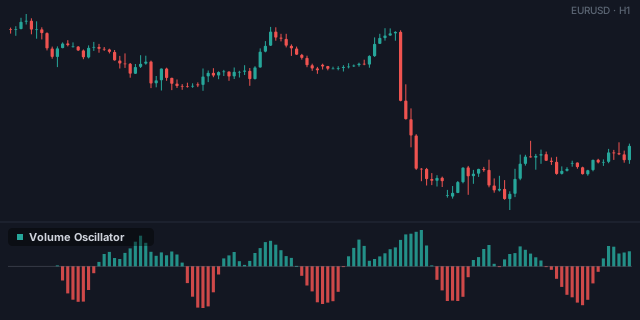
Demand expanding participation: wire bars into the Volume Oscillator and require it positive (volume expanding) via a Greater Than against 0, combined with your breakout trigger through an And gate into a Tester, filtering out low-participation fakeouts. Backtest in the Tester.
Tips & gotchas
- Percentage gap = comparable. Unlike raw volume, it reads the same across instruments and time.
- Direction-agnostic. It measures participation, not price — always pair with a price trigger.
- Rising vol confirms, falling vol warns — expanding participation supports a move; contracting hints at exhaustion.
- Fast/slow spread sets sensitivity — closer periods react faster and noisier.
Related blocks
Inputs
| Socket | Type | What to wire in |
|---|---|---|
| Source | bars |
Price bars (needs volume) |
Outputs
| Output | Type | Plots as | Description |
|---|---|---|---|
| VO | series |
Histogram · sub-pane | Volume Oscillator (%) |
| Bull ↑ | signal |
Signal arrows | VO crosses above zero |
| Bear ↓ | signal |
Signal arrows | VO crosses below zero |
Parameters
| Parameter | Type | Default | What it does |
|---|---|---|---|
| Fast period | number · 1–100 | 5 |
|
| Slow period | number · 2–200 | 10 |
|
| Histogram colors | choice (Green / Red, Blue / Orange, Teal / Magenta, Lime / Crimson, Mono) |
Green / Red |
Reference auto-generated from the block catalog · category Indicators.