Vortex
Indicators · Momentum
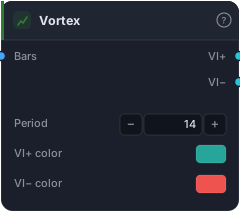
Botes & Siepman's positive / negative vortex movement.
The Vortex Indicator identifies the start of a new trend and its direction using two lines that chase each other: VI+ (positive vortex movement) and VI− (negative). When VI+ is above VI−, upward movement dominates — an uptrend; when VI− leads, a downtrend. The crossover of the two lines is a clean trend-change signal, and the distance between them measures how strongly the prevailing direction is winning. It's a modern (2010) take on directional movement, conceptually a cousin of the DI lines in ADX / DMI.
How it works
For each bar the block measures upward "vortex movement" (this bar's high versus the previous low) and downward vortex movement (this bar's low versus the previous high), then sums each over the Period (default 14) and normalises by the summed true range. VI+ captures the strength of upward movement, VI− the downward; both plot in a sub-pane, typically oscillating around 1.0. When VI+ crosses above VI−, upward movement has taken over; the reverse marks a turn down.
When to use it
Use the Vortex for trend entries and trend-change timing. The VI+ / VI− crossover is the core signal — go with whichever line takes the lead. The width of the gap between them gauges trend conviction: wide and separating means a strong, accelerating trend; converging lines warn it's weakening. Like all crossover systems it whipsaws in ranges, so confirm with a trend-strength gauge. It pairs naturally with ADX — Vortex for direction, ADX for strength.
Example
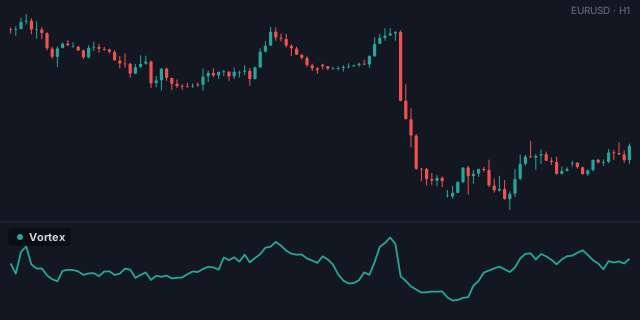
A direction-plus-strength entry: wire bars into Vortex and into ADX / DMI; take the VI+ crosses VI− event via a Crosses Above only when ADX confirms a real trend, combined through an And gate into a Tester. Protect with a Tester and backtest in the Tester.
Tips & gotchas
- The crossover is the signal; the gap width is the conviction.
- Whipsaws in ranges like any crossover — pair it with a strength filter (ADX/Choppiness).
- Direction, not strength. Vortex says which way; let ADX say how strongly.
- Longer Period = smoother, fewer false crosses but later entries.
Related blocks
Inputs
| Socket | Type | What to wire in |
|---|---|---|
| Bars | bars |
OHLC bars (high/low/close required) |
Outputs
| Output | Type | Plots as | Description |
|---|---|---|---|
| VI+ | series |
Line · sub-pane | Positive vortex movement (upward trend strength) |
| VI− | series |
Line · sub-pane | Negative vortex movement (downward trend strength) |
Parameters
| Parameter | Type | Default | What it does |
|---|---|---|---|
| Period | number · 2–500 | 14 |
Window length for the VM/TR summations |
| VI+ color | colour | #26a69a |
|
| VI− color | colour | #ef5350 |
Reference auto-generated from the block catalog · category Indicators.