Chaikin Volatility
Indicators · Volatility

Rate of change of the smoothed high-low range.
Chaikin Volatility measures how fast the market's trading range is expanding or contracting. Rather than tracking how far price has moved, it tracks the spread between highs and lows — the width of the bars — and reports how quickly that width is changing. A sharp rise means volatility is exploding (ranges widening fast); a fall means the market is calming down. It's a momentum gauge for volatility itself.
How it works
The block first smooths the high-low range of each bar with an EMA over the EMA period (default 10), then takes the percentage rate of change of that smoothed range over the Change lookback (default 10) bars. So a reading of +30% means the average bar range is 30% wider than it was ten bars ago. The output is a single line in a sub-pane, swinging above and below zero as ranges expand and contract.
When to use it
Use Chaikin Volatility to time volatility expansions and exhaustion. Marc Chaikin's own observation: tops often form with rising volatility (panic, wide bars) while bottoms form during low, calming volatility — so a spike can flag an emotional extreme. More practically, a sharp rise confirms a breakout has real range behind it, while a collapse toward a low signals compression (a coming squeeze). It's a confirmation/context tool, not a directional one — it never tells you up or down.
Example
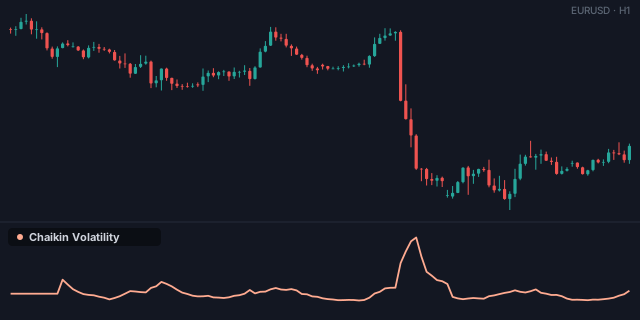
Confirm a breakout has energy: wire bars into Chaikin Volatility and require it rising (ranges expanding) via a comparison, combined with your breakout trigger through an And gate into a Tester, so low-energy fakeouts get filtered out. Backtest in the Tester.
Tips & gotchas
- It's the rate-of-change of range, not of price — direction-agnostic volatility momentum.
- Rising vol near a top, calm vol near a bottom is Chaikin's classic read — useful context, not a standalone signal.
- Two windows shape it — the EMA smoothing and the change lookback; start at 10/10.
- Pair with a price signal for direction; on its own it only measures energy.
Related blocks
Inputs
| Socket | Type | What to wire in |
|---|---|---|
| Bars | bars |
Price bars |
Outputs
| Output | Type | Plots as | Description |
|---|---|---|---|
| CV | series |
Line · sub-pane | Chaikin Volatility (%) |
Parameters
| Parameter | Type | Default | What it does |
|---|---|---|---|
| EMA period | number · 2–200 | 10 |
|
| Change lookback | number · 1–200 | 10 |
|
| Line color | colour | #ffab91 |
Reference auto-generated from the block catalog · category Indicators.