Standard Deviation
Indicators · Volatility
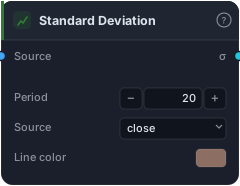
Rolling standard deviation of a price series.
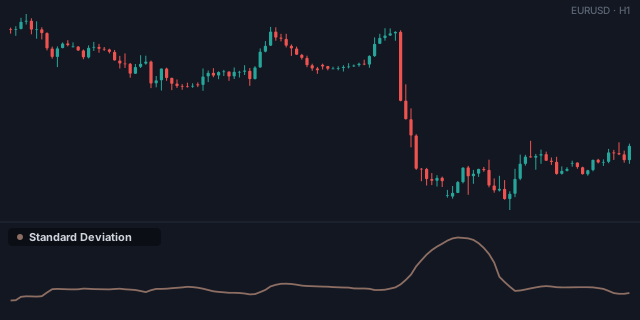
Standard Deviation measures how spread-out price has been over a recent window — in plain terms, how much it's been bouncing around its own average. It's the raw, statistical core of volatility: a low reading means price is coiled and quiet, a high reading means it's wild and stretched. It's both a standalone volatility gauge and the building block underneath Bollinger Bands.
How it works
Over the Period (default 20) the block computes the standard deviation of the Source — the square root of the average squared distance of each value from the window's mean. The output is one value per bar in a sub-pane, in the instrument's price units. Rising σ means volatility is expanding; falling σ means it's contracting. Because it's an absolute (not normalised) measure, "high" and "low" are relative to each instrument's own history.
When to use it
Use Standard Deviation to read and gate on volatility. Common plays: only take breakout entries when σ is rising (a volatility expansion confirms the move has energy), or only take mean-reversion trades when σ is moderate (extreme σ means a violent move you don't want to fade). A σ contracting to a multi-bar low is a classic "squeeze" precursor — the calm before a breakout. Feed it into a comparison to turn those ideas into rules.
Example
A volatility-gated breakout: wire bars into Standard Deviation and require σ to be above its recent norm (rising volatility) via a comparison, combined with your breakout trigger through an And gate into a Tester. This keeps you out of low-energy fakeouts. Backtest in the Tester.
Tips & gotchas
- Absolute, not normalised. Its scale is in price units, so it's not comparable across instruments — for a comparable %, use Historical Volatility.
- It's the engine inside Bollinger Bands — band width is just a multiple of this.
- Low σ → squeeze. A contraction to a multi-bar low often precedes a breakout.
- Direction matters more than level — rising vs falling σ tells you whether to expect expansion or calm.
Related blocks
Inputs
| Socket | Type | What to wire in |
|---|---|---|
| Source | bars / series |
Price bars or any indicator series |
Outputs
| Output | Type | Plots as | Description |
|---|---|---|---|
| σ | series |
Line · sub-pane | Rolling σ |
Parameters
| Parameter | Type | Default | What it does |
|---|---|---|---|
| Period | number · 2–500 | 20 |
|
| Source | choice (close, open, high, low, hl2, hlc3, ohlc4) |
close |
|
| Line color | colour | #8d6e63 |
Reference auto-generated from the block catalog · category Indicators.