DeMarker
Indicators · Oscillators
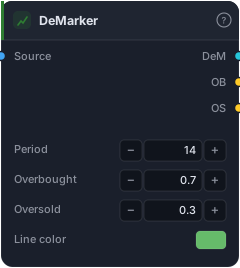
DeMarker — 0..1 bounded exhaustion oscillator on bar extremes.
The DeMarker (DeM) is an exhaustion oscillator that, unlike most, is built from the highs and lows of each bar rather than the closes. Tom DeMark designed it to spot when a move is running out of new ground — when bars stop making higher highs (buying exhaustion) or lower lows (selling exhaustion). It's bounded 0 to 1, which makes its overbought/oversold zones clean and easy to threshold.
How it works
For each bar the block measures DeMax (how much higher this bar's high is than the last — buying demand) and DeMin (how much lower this bar's low is than the last — selling demand). Over the Period (default 14) it averages each, then computes DeM = DeMax / (DeMax + DeMin) — the share of recent range that came from new highs. The result sits between 0 and 1: near 1 means almost all recent extension was upward (overbought), near 0 means downward (oversold). The block draws Overbought (0.7) and Oversold (0.3) guides with matching OB/OS signals.
When to use it
Use DeMarker to anticipate exhaustion and reversals, especially in ranges or at the tail of a stretched move. Because it reads bar extremes rather than closes, it can flag waning momentum a touch earlier than close-based oscillators. The standard play is fading: look for DeM to turn down out of 0.7 or up out of 0.3. As always with a bounded oscillator, a reading that stays pinned at an extreme during a strong trend is continuation, not a top — confirm the turn.
Example
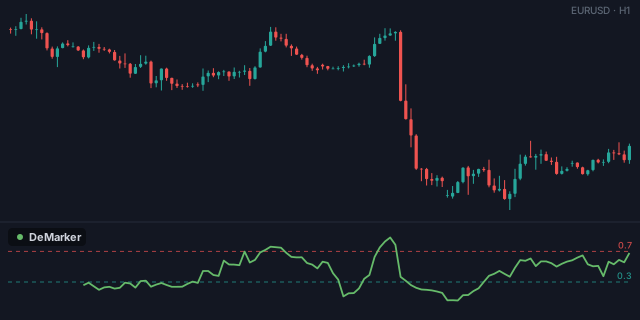
A range fade: wire bars into DeMarker, take the OS signal with DeM turning up through 0.3 via a Crosses Above, routed into a Tester, and only in a non-trending regime (ADX / DMI gate). Protect with a Tester below the swing low and backtest in the Tester.
Tips & gotchas
- Built on highs/lows, not closes — that's what sets it apart and can make it slightly earlier.
- Bounded 0–1 makes thresholds clean; 0.7/0.3 is convention, tighten to 0.8/0.2 for rarer signals.
- Don't fade a strong trend — a pinned DeM is momentum, not a reversal.
- Turn out of the zone > touch of the zone for entry timing.
Related blocks
Inputs
| Socket | Type | What to wire in |
|---|---|---|
| Source | bars |
Price bars (needs high + low) |
Outputs
| Output | Type | Plots as | Description |
|---|---|---|---|
| DeM | series |
Line · sub-pane | DeMarker value (0..1) |
| OB | signal |
— | True when DeM is above the overbought threshold |
| OS | signal |
— | True when DeM is below the oversold threshold |
Parameters
| Parameter | Type | Default | What it does |
|---|---|---|---|
| Period | number · 2–200 | 14 |
|
| Overbought | number · 0.5–1.0 | 0.7 |
|
| Oversold | number · 0.0–0.5 | 0.3 |
|
| Line color | colour | #66bb6a |
Chart guides
This indicator draws reference level(s): overbought, oversold.
Reference auto-generated from the block catalog · category Indicators.