Ease of Movement
Indicators · Volume
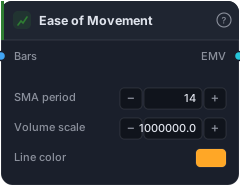
How easily price moves per unit of volume (Arms).
Ease of Movement (EMV), developed by Richard Arms, answers a subtle question: how hard did the market have to work to move price? When price travels a long way on light volume, movement is "easy" — a sign of a frictionless, healthy trend. When price barely budges despite heavy volume, movement is "hard" — buyers and sellers are fighting and the trend is struggling. EMV turns that relationship into a single oscillator around zero.
How it works
For each bar the block computes a "distance moved" term (how far the bar's midpoint shifted from the previous bar's) and divides it by a "box ratio" (volume scaled by the bar's range) — so large price moves on small volume produce big positive EMV, and small moves on big volume produce near-zero or negative EMV. The Volume scale (default 1,000,000) just keeps the raw numbers readable, and the result is smoothed with an SMA over the SMA period (default 14). The output is one line in a sub-pane: above zero, price is rising easily; below zero, falling easily.
When to use it
Use EMV to judge trend health and confirm breakouts. A breakout accompanied by high, positive EMV is moving with little resistance — high quality. A move on low EMV is grinding against opposition and more likely to stall. The zero-line cross is a simple trend-direction signal, and EMV diverging from price hints the current move is getting harder to sustain. It's a confirmation tool; on forex it uses tick volume.
Example
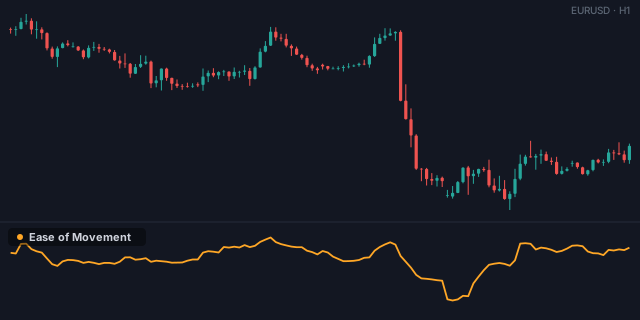
Quality-filter a breakout: wire bars into Ease of Movement and require EMV above zero (price moving up easily) via a Greater Than against 0, combined with your breakout trigger through an And gate into a Tester. Backtest in the Tester to confirm the filter favours frictionless moves.
Tips & gotchas
- Price move ÷ volume effort — high EMV means price moved far on little volume (easy, healthy).
- Zero cross = direction; divergence = a tiring move.
- The volume scale is cosmetic — it only rescales the numbers, not the meaning.
- Confirmation, not a trigger — pair with a price signal.
Related blocks
Inputs
| Socket | Type | What to wire in |
|---|---|---|
| Bars | bars |
Price bars |
Outputs
| Output | Type | Plots as | Description |
|---|---|---|---|
| EMV | series |
Line · sub-pane | Smoothed EMV |
Parameters
| Parameter | Type | Default | What it does |
|---|---|---|---|
| SMA period | number · 2–200 | 14 |
|
| Volume scale | number · 1.0–1000000000.0 | 1000000.0 |
|
| Line color | colour | #ffa726 |
Reference auto-generated from the block catalog · category Indicators.