Fisher Transform
Indicators · Momentum
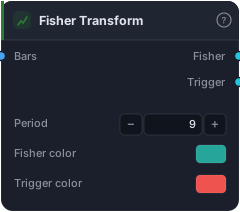
Ehlers's Fisher Transform of (high+low)/2.
John Ehlers's Fisher Transform takes price — which has fat, lazy tails and rarely produces sharp turning points — and mathematically reshapes it into something closer to a bell curve, where extremes become rare and obvious. The effect is dramatic: turning points that look mushy on a normal oscillator become sharp, spiky reversals on the Fisher. It's built to call tops and bottoms with unusual decisiveness.
How it works
Over the Period (default 9) the block normalises the bar's median price (high + low) / 2 to a −1…+1 range, then runs it through the Fisher transform — a function that stretches values near the edges toward infinity. The result, the Fisher line, spikes hard at extremes. A second Trigger line is simply the Fisher shifted one bar back; when Fisher crosses its trigger, that's the signal. Both plot in a sub-pane and swing around zero.
When to use it
Use the Fisher Transform to time reversals. Its sharp spikes at extremes make exhaustion easy to see, and the Fisher/Trigger crossover gives a crisp entry — far less ambiguous than a slow oscillator's gentle roll. It's most useful in ranges and at the end of stretched moves. The flip side of all that sharpness is whippiness: it reacts fast and can fire early, so confirm with structure or a trend filter rather than trading every spike.
Example
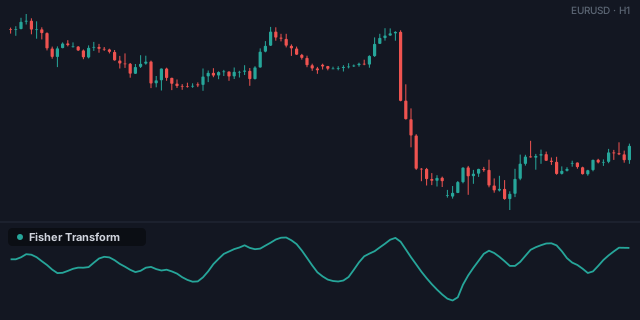
Reversal timing: wire bars into the Fisher Transform and feed a Fisher-crosses-Trigger event through a Crosses Above into a Tester, taken when the Fisher is deep negative (stretched down). Confirm at a Supply/Demand Zone for higher quality, protect with a Tester, and backtest in the Tester.
Tips & gotchas
- Sharp turns are the point. The transform exaggerates extremes so reversals stand out — but that also makes it twitchy.
- The Trigger cross is the signal, not the Fisher level alone.
- It's unbounded at the edges. Spikes can run large; the cross back matters more than the absolute peak.
- Confirm it. Its speed means early/false signals — pair with structure or a trend gate.
Related blocks
Inputs
| Socket | Type | What to wire in |
|---|---|---|
| Bars | bars |
OHLC bars (high/low required) |
Outputs
| Output | Type | Plots as | Description |
|---|---|---|---|
| Fisher | series |
Line · sub-pane | Fisher-transformed price (gaussianised) |
| Trigger | series |
Line · sub-pane | One-bar-shifted Fisher — crossovers are the signal |
Parameters
| Parameter | Type | Default | What it does |
|---|---|---|---|
| Period | number · 2–200 | 9 |
Lookback window for the price normalisation |
| Fisher color | colour | #26a69a |
|
| Trigger color | colour | #ef5350 |
Reference auto-generated from the block catalog · category Indicators.