Greater or Equal
Signals · Comparison
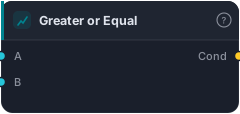
True where a >= b.
Greater-or-Equal is a persistent comparison: it's True on every bar where A ≥ B. Unlike a crossover, which fires once at the moment of change, this stays true for as long as the condition holds — the right tool when you care about an ongoing state, not an event.
How it works
Each bar it aligns A and B onto a shared timeline and outputs True where A is greater than or equal to B, False otherwise. Both inputs are series, so B can be another indicator or a Constant threshold. The "or-equal" boundary means an exact touch counts as true (the difference from the strict GreaterThan). Lookahead-free.
When to use it
Use it as a filter or gate: "trade only while price is at or above the VWAP," "RSI at or above 50." It's the inclusive-threshold state check you And with an entry trigger. Reach for GreaterThan when the boundary itself shouldn't count, and for CrossesAbove when you want the moment of crossing, not the ongoing state.
Example
Above-VWAP filter: wire close into A and VWAP into B, then And the Greater-or-Equal output with a CrossesAbove entry so longs only fire while price is at or above VWAP.
Tips & gotchas
- Persistent state, not an event — true for many bars; use CrossesAbove for the trigger.
- Inclusive boundary (
≥) — an exact equality counts as true. - Wire a Constant into B for a fixed threshold.
Related blocks
Inputs
| Socket | Type | What to wire in |
|---|---|---|
| A | series |
Left-hand series — the one DOING the crossing. In an MA crossover this is the FAST line (e.g. EMA-20). In an RSI trigger this is the RSI line itself. |
| B | series |
Right-hand series — the REFERENCE being crossed. In an MA crossover this is the SLOW line (e.g. EMA-50). In an RSI trigger this is the threshold (e.g. constant 30). |
Outputs
| Output | Type | Plots as | Description |
|---|---|---|---|
| Cond | signal |
Signal arrows | Boolean result of the comparison |
Reference auto-generated from the block catalog · category Signals.