Pivot Points
Indicators · Levels
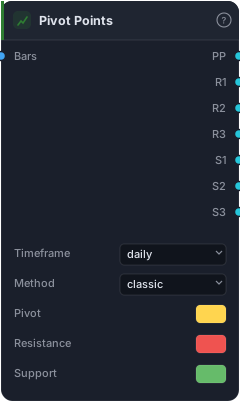
Classic / Fibonacci / Camarilla / Woodie pivots from prior period HLC.
Pivot Points project support and resistance levels for today from yesterday's range. Using the prior period's high, low, and close, they compute a central pivot (PP) and a ladder of support (S1–S3) and resistance (R1–R3) levels — horizontal lines that day traders and institutions watch as decision points. Because they're derived purely from completed prior data, the whole map is known in advance, which is why they're such a popular framework for planning a session.
How it works
From the previous period's HLC (the Timeframe — daily or weekly) the block computes a central PP and three levels each of resistance (R1/R2/R3) and support (S1/S2/S3). The Method picks the formula: classic (the standard pivot maths), fibonacci (levels spaced by Fib ratios of the prior range), camarilla (tighter levels favoured by mean-reversion traders), or woodie (close-weighted). All seven plot as lines on the price pane and hold for the whole period, stepping to new values when the period rolls over.
When to use it
Use Pivot Points as a pre-planned map of intraday levels. Common plays: fade moves at R1/S1 back toward PP in a range; treat a break and hold beyond R1/S1 as a trend signal targeting R2/S2; and watch PP itself as the day's bull/bear dividing line (above = bullish bias, below = bearish). The method matters — camarilla's tight levels suit mean reversion, classic/fibonacci suit broader S/R. Like all level tools, they mark where, not when — pair with a trigger.
Example
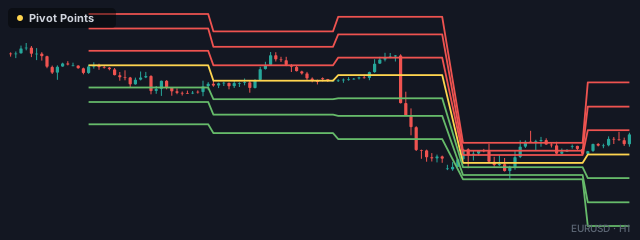
A pivot fade: wire bars into Pivot Points (daily, classic) and fade a tag of R1 back toward PP — combine the level touch with a bearish trigger into a Tester, stop above R2. Or trade PP reclaims for bias. Backtest in the Tester.
Tips & gotchas
- Known in advance — derived from completed prior data, so the whole map is set at the open.
- PP is the bull/bear line; R/S are the targets and fade zones.
- Method changes the levels —
camarillatight (mean reversion),classic/fibonacciwider (S/R). - Location, not timing — pair with a trigger; pivots line up powerfully with Fibonacci and round numbers.
Related blocks
Inputs
| Socket | Type | What to wire in |
|---|---|---|
| Bars | bars |
Price bars |
Outputs
| Output | Type | Plots as | Description |
|---|---|---|---|
| PP | series |
Line | Pivot (PP) |
| R1 | series |
Line | Resistance 1 |
| R2 | series |
Line | Resistance 2 |
| R3 | series |
Line | Resistance 3 |
| S1 | series |
Line | Support 1 |
| S2 | series |
Line | Support 2 |
| S3 | series |
Line | Support 3 |
Parameters
| Parameter | Type | Default | What it does |
|---|---|---|---|
| Timeframe | choice (daily, weekly) |
daily |
Which period's HLC to pivot on |
| Method | choice (classic, fibonacci, camarilla, woodie) |
classic |
|
| Pivot | colour | #ffd54f |
|
| Resistance | colour | #ef5350 |
|
| Support | colour | #66bb6a |
Reference auto-generated from the block catalog · category Indicators.