Ultimate Oscillator
Indicators · Oscillators
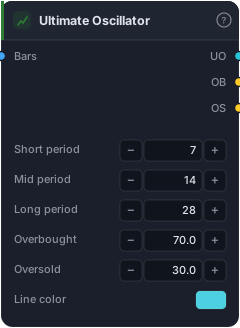
Ultimate Oscillator — weighted multi-window buying pressure.
Larry Williams designed the Ultimate Oscillator to fix a flaw shared by most momentum oscillators: they run on a single look-back, so they're forever reacting to whichever period you happened to pick and throwing false divergences when that period is wrong. The Ultimate Oscillator blends three time-frames of buying pressure into one 0–100 line, so it's less twitchy and gives cleaner, better-confirmed signals than a single-window oscillator like a short RSI.
How it works
For each bar the block measures "buying pressure" (where the close sits relative to the bar's true range) and averages it over three windows — Short period (7), Mid period (14), and Long period (28). It then combines them with weights of 4 : 2 : 1, favouring the shortest window for responsiveness while letting the longer ones steady it. The output is a 0–100 line in a sub-pane, with Overbought (70) and Oversold (30) thresholds and matching OB/OS signals.
When to use it
Use it as a smoother, multi-timeframe momentum and divergence read. Williams's original method looked for divergence between price and the oscillator at the extremes, then entered on a break of the oscillator's pivot. Because it triangulates three windows, its divergences are more trustworthy than a single-period oscillator's — fewer fakeouts. It still lags somewhat (three averages will), so treat it as confirmation rather than a leading trigger.
Example
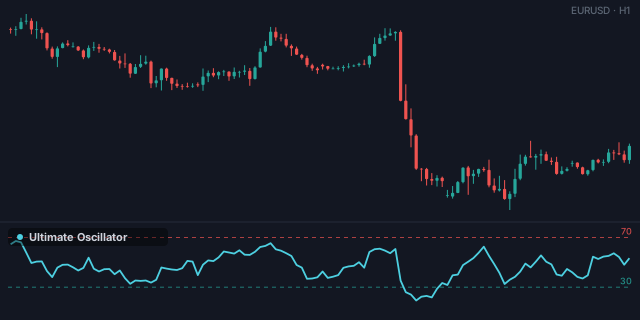
Confirmed reversal: wire bars into the Ultimate Oscillator, look for the OS zone plus the line turning up via a Crosses Above, and route to a Tester — ideally only when ADX / DMI says the trend is weak enough to fade. Protect with a Tester and backtest in the Tester.
Tips & gotchas
- Three windows = fewer false divergences than a single-period oscillator — that's its whole reason to exist.
- The 4:2:1 weighting leans on the short window; widen all three proportionally for slower signals.
- Still lags — it confirms, it doesn't lead.
- Divergence is the classic use, per Williams's original playbook.
Related blocks
Inputs
| Socket | Type | What to wire in |
|---|---|---|
| Bars | bars |
Price bars |
Outputs
| Output | Type | Plots as | Description |
|---|---|---|---|
| UO | series |
Line · sub-pane | Ultimate Oscillator (0..100) |
| OB | signal |
— | Above overbought |
| OS | signal |
— | Below oversold |
Parameters
| Parameter | Type | Default | What it does |
|---|---|---|---|
| Short period | number · 2–100 | 7 |
|
| Mid period | number · 2–200 | 14 |
|
| Long period | number · 2–400 | 28 |
|
| Overbought | number · 50.0–100.0 | 70.0 |
|
| Oversold | number · 0.0–50.0 | 30.0 |
|
| Line color | colour | #4dd0e1 |
Chart guides
This indicator draws reference level(s): overbought, oversold.
Reference auto-generated from the block catalog · category Indicators.