Donchian Channels
Indicators · Bands & Channels
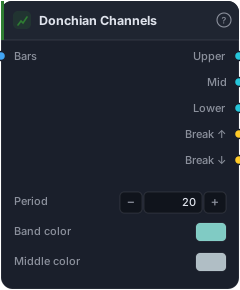
Rolling HH / LL envelope — the classic turtle breakout channel.
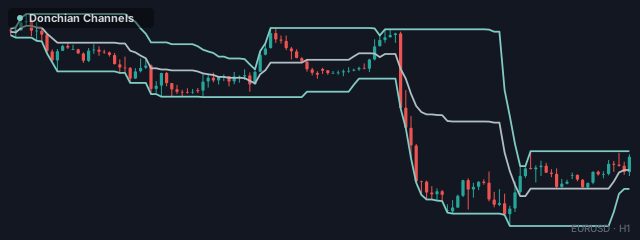
Donchian Channels draw the highest high and lowest low of the last N bars as two lines, with their midpoint between. It's the simplest channel there is — and one of the most famous, because it's the core of the legendary Turtle Traders' breakout system. The upper line is "the highest price anyone's paid recently"; a close above it means price has broken to new ground, which is the purest definition of a breakout.
How it works
Over the Period (default 20) the block plots the Upper line as the rolling highest high, the Lower line as the rolling lowest low, and the Mid line as their average. When price makes a fresh N-bar high or low, the block fires Break ↑ or Break ↓ (drawn as arrows) — these are the breakout events the channel exists to flag. There's nothing to smooth or tune beyond the look-back period itself.
When to use it
Donchian Channels are a breakout and trend tool. The Turtle approach: go long on a break of the upper channel, short on a break of the lower, and use a shorter-period opposite channel as the trailing exit. They work best in markets prone to sustained trends and worst in choppy ranges, where price pokes just past the channel and reverses (the classic false breakout). The Mid line is also a decent mean-reversion target and dynamic support/resistance.
Example
A turtle-style breakout: wire bars into a Period 20 Donchian Channel and route Break ↑ into a Tester, gated by ADX / DMI so you only take breaks when a trend has strength behind it (cutting the false pokes). Trail the exit with a shorter Donchian or a Tester, and backtest in the Tester.
Tips & gotchas
- It's the original breakout channel — simple, robust, and famously profitable in trending markets.
- False breakouts are the enemy. Filter with a trend/volatility gauge (ADX / DMI, Choppiness) to skip the chop.
- Period is everything — shorter channels break often (noisy), longer ones break rarely (cleaner, later).
- Use two channels — a long one for entry, a shorter opposite one for the trailing exit.
Related blocks
Inputs
| Socket | Type | What to wire in |
|---|---|---|
| Bars | bars |
Price bars |
Outputs
| Output | Type | Plots as | Description |
|---|---|---|---|
| Upper | series |
Line | Rolling highest high |
| Mid | series |
Line | Midline of the channel |
| Lower | series |
Line | Rolling lowest low |
| Break ↑ | signal |
Signal arrows | New high broken |
| Break ↓ | signal |
Signal arrows | New low broken |
Parameters
| Parameter | Type | Default | What it does |
|---|---|---|---|
| Period | number · 2–500 | 20 |
|
| Band color | colour | #80cbc4 |
|
| Middle color | colour | #b0bec5 |
Reference auto-generated from the block catalog · category Indicators.