Keltner Channels
Indicators · Bands & Channels
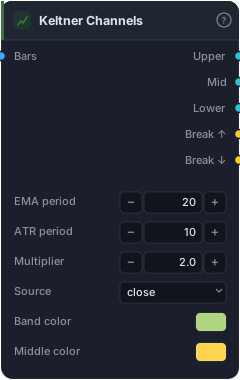
EMA centerline ± N × ATR envelope.
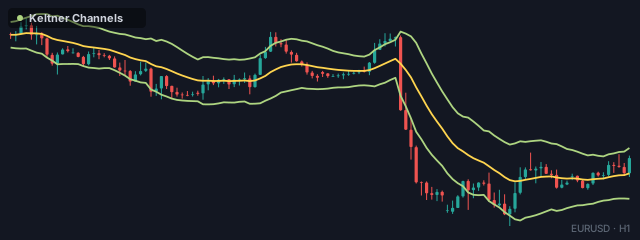
Keltner Channels wrap price in a volatility envelope built from an EMA spine and ATR-based bands. They look a lot like Bollinger Bands, but with one important difference: where Bollinger's width comes from standard deviation (which reacts to both trend and noise), Keltner's width comes from ATR (pure range). The result is a smoother, steadier channel that's especially good for reading trend and spotting clean breakouts.
How it works
The Mid line is an EMA of the Source over the EMA period (default 20). The Upper and Lower channels sit Multiplier (default 2.0) times the ATR — measured over the ATR period (default 10) — above and below that midline. Because ATR is a smooth measure of average range, the bands expand and contract gently rather than snapping around. The block also exposes Break ↑ / Break ↓ signals when price closes beyond a channel.
When to use it
Keltner Channels have two classic uses. Trend riding: in a strong trend price "rides" the upper (or lower) channel — a touch there is continuation, and the midline EMA is your trailing reference. Breakout: a close decisively outside the channel after a quiet stretch signals a volatility expansion worth trading. They pair famously with Bollinger Bands in the squeeze — when the narrower Bollingers sit inside the Keltners, volatility is compressed and a move is brewing (see Squeeze Momentum).
Example
A trend-pullback entry: wire bars into Keltner Channels and define bias from the Mid EMA slope; on a pullback to the midline in an uptrend, trigger via a Crosses Above into a Tester. Use the lower channel as your Tester reference and backtest in the Tester.
Tips & gotchas
- ATR width = smoother than Bollinger. Fewer false flares because noise alone doesn't widen it.
- Don't fade a ridden channel. Price hugging the upper band in a trend is strength, not a top.
- The squeeze is the headline pairing — Bollinger inside Keltner is one of the most-watched compression signals.
- Multiplier tunes sensitivity — wider (2.5–3) for fewer, cleaner breaks; tighter for more.
Related blocks
Inputs
| Socket | Type | What to wire in |
|---|---|---|
| Bars | bars |
Price bars |
Outputs
| Output | Type | Plots as | Description |
|---|---|---|---|
| Upper | series |
Line | Upper channel |
| Mid | series |
Line | EMA middle line |
| Lower | series |
Line | Lower channel |
| Break ↑ | signal |
— | Close above upper channel |
| Break ↓ | signal |
— | Close below lower channel |
Parameters
| Parameter | Type | Default | What it does |
|---|---|---|---|
| EMA period | number · 2–500 | 20 |
|
| ATR period | number · 2–200 | 10 |
|
| Multiplier | number · 0.1–10.0 | 2.0 |
|
| Source | choice (close, open, high, low, hl2, hlc3, ohlc4) |
close |
|
| Band color | colour | #aed581 |
|
| Middle color | colour | #ffd54f |
Reference auto-generated from the block catalog · category Indicators.