Relative Volatility Index
Indicators · Volatility
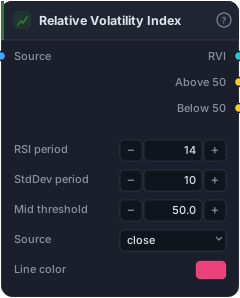
Relative Volatility Index (Dorsey) — RSI of stddev: direction of volatility.
The Relative Volatility Index (RVI), another Donald Dorsey creation, is essentially an RSI run on volatility instead of price. Where RSI measures whether price changes have been net up or down, the RVI measures whether volatility (standard deviation) has been rising more on up-bars or down-bars. The idea is that volatility tends to expand in the direction of the real move, so the RVI confirms a trend's direction with a volatility lens — a useful, independent second opinion to pair with price-based indicators.
How it works
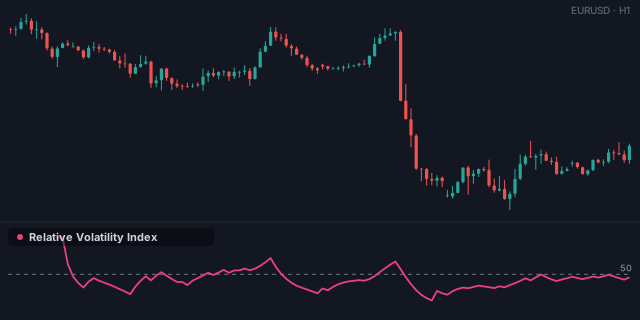
The block computes the rolling standard deviation of the Source over the StdDev period (10), then applies the RSI calculation to that — separating volatility on up-closes from volatility on down-closes over the RSI period (14). The output is a 0–100 line in a sub-pane with a Mid threshold (50). Above 50 means volatility is expanding more on up-moves (confirming bullish strength); below 50, on down-moves (bearish). Above 50 / Below 50 signals expose those states.
When to use it
Use the RVI as a confirmation filter alongside a price-based signal — Dorsey designed it to be used with indicators like moving-average crosses, not alone. The logic: only take a long when the RVI confirms (above 50, volatility expanding upward) and a short when it's below 50. Because it reads volatility rather than price, it catches a different aspect of the move and filters out signals where the volatility isn't backing the price direction. It's a second opinion, not a primary trigger.
Example
Volatility-confirmed crossover: take an EMA crossover entry and require the RVI above 50 (volatility expanding upward) through an And gate into a Tester — so you only take the crossover when volatility backs the direction. Backtest with and without the RVI filter in the Tester.
Tips & gotchas
- RSI of volatility — it reads volatility's direction, not price's.
- Designed as a confirmation filter — Dorsey meant it to gate price signals, not trigger alone.
- Above 50 = upward volatility expansion (bullish confirm); below 50 the reverse.
- A different lens — catches what price-only indicators miss.
Related blocks
Inputs
| Socket | Type | What to wire in |
|---|---|---|
| Source | bars / series |
Price bars or any indicator series |
Outputs
| Output | Type | Plots as | Description |
|---|---|---|---|
| RVI | series |
Line · sub-pane | Relative Volatility Index (0..100) |
| Above 50 | signal |
— | True when RVI > mid threshold (rising vol on up bars). |
| Below 50 | signal |
— | True when RVI < mid threshold (rising vol on down bars). |
Parameters
| Parameter | Type | Default | What it does |
|---|---|---|---|
| RSI period | number · 2–200 | 14 |
|
| StdDev period | number · 2–200 | 10 |
|
| Mid threshold | number · 0.0–100.0 | 50.0 |
|
| Source | choice (close, open, high, low, hl2, hlc3, ohlc4) |
close |
|
| Line color | colour | #ec407a |
Chart guides
This indicator draws reference level(s): mid.
Reference auto-generated from the block catalog · category Indicators.