Rolling Min
Math · Rolling
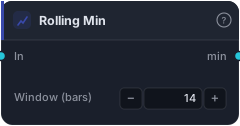
Lowest value in the trailing N bars.
Rolling Min reports the lowest value of a series over the trailing N bars — the mirror of Rolling Max. It traces the recent trough, like the lowest low of the last 20 bars, and it's the building block behind downside breakouts, channel bottoms, and trailing-stop references for shorts.
How it works
Each bar the block outputs the minimum of the source over the Window (bars) (default 14). Feed it Bars (uses close) or any series. It steps down when a new low enters the window and rises as old lows age out. Rolling Min of the low is the lower line of a Donchian Channel.
When to use it
Use Rolling Min to build downside breakout and trailing levels. A close breaking below the rolling min of the last N lows is an N-bar downside breakout (short entry). For longs, the rolling min is a natural trailing-stop reference — the recent swing low. Pair it with Rolling Max to hand-build a channel, or compare price to it with a Crosses Below for a breakdown trigger.
Example
A trailing-stop reference: take the Rolling Min of price over 10 bars and use it as a Tester-style level for a long — the stop trails the recent low. Or feed it as B into a Crosses Below for a 10-bar breakdown short. Backtest in the Tester.
Tips & gotchas
- The downside-breakout primitive — rolling min of lows = the lower Donchian line.
- A natural trailing reference for longs (the recent swing low).
- Pair with Rolling Max for a custom channel.
- Window sets sensitivity — short = minor lows, long = major ones.
Related blocks
Inputs
| Socket | Type | What to wire in |
|---|---|---|
| In | series / bars |
Source series. BARS input uses close. |
Outputs
| Output | Type | Plots as | Description |
|---|---|---|---|
| min | series |
Line · sub-pane | Per-bar rolling min. |
Parameters
| Parameter | Type | Default | What it does |
|---|---|---|---|
| Window (bars) | number · 2–500 | 14 |
Bars in the rolling window. |
Reference auto-generated from the block catalog · category Math.